

Comments Off on Penwarden Fine Jewellery Email Newsletter, April 2022
Posted in Branding, Penwarden Fine Jewellery
Tagged Email Newsletter, jewellery, Jewellery trends, Jewellery Wardrobe, Jewelry, Mother's Day

This ancient gem cut will never go out of style and including it in your collection will ensure it sings of history.
Before there were several types of gem cuts and shapes available including custom, fantasy and designer cuts created with high-tech machinery and lasers, gem traders had very little resources in the way of shaping and refining the Earth’s greatest materials.
While many gemstones are still cut by hand, the earliest forms of hand-cut gems took the shape of beads, followed by ancient cabochon cuts (sometimes just referred to as “cabs.”) Read more about the history of gem cutting.
Cabochons are dome-shaped, often with a round or oval-outline and a flat bottom. Double-cabochons are domed on top and bottom. The etymology of the word “cabochon” comes from an Old French term meaning little head.
While cabochons are often used to show off a gem’s excellent colour and saturation (which is any jewel’s most important value factor) they can also be ideal for specimens which may have slightly lower clarity. Some gem varieties can only be cut as cabochons due to their physical structure or if they are classified as “phenomenal.” The latter includes Star Sapphires and Rubies, which require the smooth surface to show off their natural asterism, chatoyant gems, such as Cat’s Eye Chrysoberyl, Moonstones, and Opals, which display a magical play-of-colour effect. Cabs are also known to hold-up better to scratches than a standard faceted cut.
This ancient cutting method was also in high demand during the Art Deco period, when exotic jewellery styles really came into fashion. These included carved cabochons, which were particularly common in the Indian-inspired “Tutti-Frutti” style, which was popularized by Cartier. Opaque gems including Turquoise, Lapis Lazuli, Jade, Onyx and Malachite, are also most often cut into cabochons as well as other cabochon variations, including carved cameos and intaglios.
The “Sugarloaf” cut is another much-loved variation of the cabochon, which is quite unique and eye-catching, and was also quite popular during the Art Deco period. This cut uses a square base, but has tapered edges along its dome that come to a soft point.
When looking at modern day cabochon-cuts, be sure to look for a symmetrical dome shape that is pleasing to the eye, as well as an even and symmetrical outline.
Comments Off on Katherine James Jewellery Custom Content, March 2022
Posted in Branding, Katherine James Jewellery
Tagged cabochon, coloured gems, Custom Content, Email Newsletter, jewellery, sugarloaf

You may not be too familiar with these stunning pink gemstones just yet, but there’s no doubt they are the perfect jewels to add some history and romance to your collection.
Kunzite is one of three varieties of the mineral Spodumene—but the only one you’ll likely every find in a piece of jewellery. Its unique name comes from the well-known gemologist George Frederick Kunz (who famously worked for Tiffany & Co.), and discovered a large deposit of the mineral in California in 1902.
Kunzite is a stunning gem that is found in light pink to violet hues. While watercolour-like colours are beautiful (and currently quite popular), in general, the more intense the saturation of this gem, the more valuable and prized it is.
Kunzite is most often mined in Afghanistan, Madagascar, Brazil and the U.S. state of California. Fine qualities of Kunzite remain quite rare, and even though it is highly valued by both gem collectors and jewellery designers, its low supply levels make it quite uncommon, and therefore still relatively unknown to many.
Kunzite is sometimes heat treated to improve it’s rosy colour, however keep in mind that regardless of whether it’s been treated or not, Kunzite has the very unique trait of sometimes fading when exposed to high heat or extreme light, so be cognizant of how you are storing these jewels when you’re not wearing them. It also rates a 6.5-7 on the Mohs Hardness Scale and has cleavage in two directions, meaning it has the potential to chip or split if it were to suffer a hard hit. However, mindful care and a well-made and protective setting can ensure this lovely gem stays in optimal condition for a lifetime.
Spodumene is often compared to Beryl, because they naturally occur in similar colours. Similar to Kunzite, Morganite is a rosy pink gemstone, which is a variety of Beryl (along with Emerald and Aquamarine.) These two gems also share similar origin stories when it comes to their namesake, and were even discovered around the same time. Morganite was actually named after another American gem enthusiast, and colleague of George Kunz, J.P. Morgan. Morgan, of course, was a famous financier with a love of mineral collecting, and in 1910, Kunz actually bestowed the name Morganite on this rosy mineral.
Finding Morganite, which gets its pink colour from manganese, in highly saturated hues is very rare, but it can vary from a light pink, to more salmon, peach and orangey colours, as well. In these combinations, it can even look similar to Padparadscha Sapphires. Similar to Kunzite, heat treatment is often used to intensify Morganite’s colour, and sometimes nix any yellow or orange tint. Unlike Kunzite, Morganite’s colour is stable and has no risk of fading when exposed to UV light or heat.
Some of the best Morganite on the market is known to come from Madagascar, though these specimens are now seldom available. Other major sources include Brazil, Mozambique, Namibia and the U.S. Similar to Aquamarine, Morganites grow in pegmatites, and can be found in excellent transparency and in very large crystal sizes. This makes them an especially good fit for cocktail rings, and excellent value for your money regardless of how you choose to include them in your jewellery collection. Of course, their beautifully romantic colours also make both of these unique and uncommon gemstones a lovely and thoughtful choice for engagement and anniversary rings and gifts.
Comments Off on Katherine James Jewellery Custom Content, March 2022
Posted in Branding, Katherine James Jewellery
Tagged coloured gemstones, Email Newsletter, engagement rings, George Kunz, jewellery, jewellery expert, jewellery writer, JP Morgan, Kunzite, Morganite, pink gemstones, romantic gemstones

Be ready to fall for Very Peri, an optimistic hue to start the new year
For over 20 years, the Pantone Colour Institute has released their colour of the year, based on a mind-bending collection of global research. To arrive at the lucky hue, experts examine a number of influential factors, including fashion and textile trends, new artists and exhibits, popular travel destinations, technological developments, film and other forms of entertainment in productions, social media platforms, upcoming sporting events, socio-economic and political conditions, home furnishing, product packaging, and really, all other matters of design.
For 2022, the Institute has named a completely new colour, which they’ve dubbed Very Peri—undoubtedly a play on periwinkle blue. While institute says the colour is considered part of the blue family (which is often used to communicated stability) but with a violet-red undertone, it is clear that this shade is in fact, purple!
According to Pantone, the choice represents an “altered landscape of possibilities, opening us up to a new vision as we rewrite our lives. Rekindling gratitude for some of the qualities that blue represents complemented by a new perspective that resonates today, Very Peri places the future ahead in a new light.” Clearly inspired by the world’s hopes and optimism for finally putting the daily worries of the pandemic and overall isolation behind us, other inspirations for the shade include the growth of digital art and design, including the rise of NFTs, the new “dynamic virtual world” (hello, Metaverse), gaming trends, and the overall fusion of the colours of our physical world with those we see on-screen.
If all these ideas of a new, virtual world have you feeling a bit lost, the good news is that the colour Purple, while perhaps a bit polarizing for some, is undoubtedly imbued with a feeling of fun, vibrancy, and overall frivolity and richness. After all, it’s a symbol of royalty and rarity, and also can be seen as the coming together of two distinct colour families: red and blue.
It’s a refreshing symbol of optimism for the future that is much welcomed, especially when you consider the shades forecasted by the institute in recent years, including a very industrial-sque pairing of grey and yellow, and a basic, banker’s blue.
Of course, we think the most exciting part of Very Peri, is how it will translate to our jewellery boxes! After years of blue and pink gems dominating the market, a return to purple feels fun again. While Amethysts, which were once considered of the rarest and most-sought after gems will likely come back into fashion in a big way (look for all saturations to return to glory, from a pale lavender to the richest purple), we also have our eye on Purple Sapphires, which have been extremely uncommon in the past if only because they were in the shadow of their royal blue counterparts, as well of course, for Kunzites and Tanzanites. Both are a rarity in the gem world, which customers are clicking to more and more in order to add massive future value to their collections, with Tanzanite in particular likely to soon ride a new wave of fame, thanks to their limited availability (with only once source, many experts agree they are likely to disappear altogether in the near future.)
Comments Off on Katherine James Jewellery Custom Content, January 2022
Posted in Branding, Katherine James Jewellery
Tagged Amethyst, colour marketing, coloured gemstones, Custom Content, Email Newsletter, Gemologist, jewellery, jewellery writing, Jewelry, Pantone, purple gemstones, sapphire, tanzanite

Mid-century jewellery will forever be loved for paving the way towards a new type of glamour.
After the heyday of ultra-glamourous Art Deco jewels, the Second World War ushered in a new era of design. Born out of the necessities of restraint and war-time restrictions, the Retro jewels of the 1940s and 50s took on a new feminine aesthetic that was optimistic, without the need for the flash of large gemstones and expensive settings.
Instead, due to the restrictions on Silver and Platinum, pieces were often crafted in Rose Gold—an alloy of gold mixed with more widely available copper. (Read more about alloys and Precious Metals.) Since sourcing large gemstones, including Daimonds and rare gems such as Sapphires and Emeralds, was becoming too difficult during war times, jewellery designers got creative with uplifting flora and fauna designs featuring smaller accent stones on the must-have items of the day, including brooches, hat pins and even cigarette and vanity cases. Bouquets of flowers were a particularly popular motif, and perfect for allowing smaller-cut gems to shine. Charms also became quite fashionable, since they showcased the wearer’s personality without necessarily requiring any gems at all.
Unlike the splashy post-war decadence of the 1920s, the period after the Second World War was still tense with an air of anxiety and lavish spending on luxury items was not returning to fashion as quickly as the first time around. In the UK specifically, the government’s new post-war “purchase tax” was raised from 30% to 125% and made luxury goods such as jewellery nearly impossibly expensive to produce and purchase. However, the latter didn’t mean that jewellery wasn’t still on the menu. In a way, it was a as popular as ever, just with a few budget-conscious adjustments.
Regardless of the lack of resources, men and women were still feverish with “proper” dress, and jewellery and accessories were as popular as ever. While men turned to tie pins and cufflinks to complete their look, matching jewellery sets including bracelets (worn with or without gloves) and bib-style necklaces were all the rage for ladies about town. Pricier Diamonds also took a backseat to cheerful, coloured gemstones which were less expensive and easier to find in large, eye-clean sizes, including Amethyst, Citrine, Smoky Quartz and Aquamarine.
Not dissimilar to the Art Deco period, which was in many ways a post-WWI rejection of the frivolity and romanticism of the Edwardian period, the 1950s and 60s ushered in a sleeker design sensibility which represented more freedom, prosperity and excitement for the future. These styles, which were at their height of popularity in the 1950s, are now known as Mid-Century Modern. Scandinavian designers such as Georg Jenson were particularly popular, and showed off more streamlined designs with geometric patterns and chunkier accent stones.
Comments Off on Katherine James Jewellery Custom Content, October 2021
Posted in Branding, Katherine James Jewellery
Tagged aquamarine, citrine, Custom Content, Email Newsletter, jewellery writer, mid-century jewellery, retro jewellery
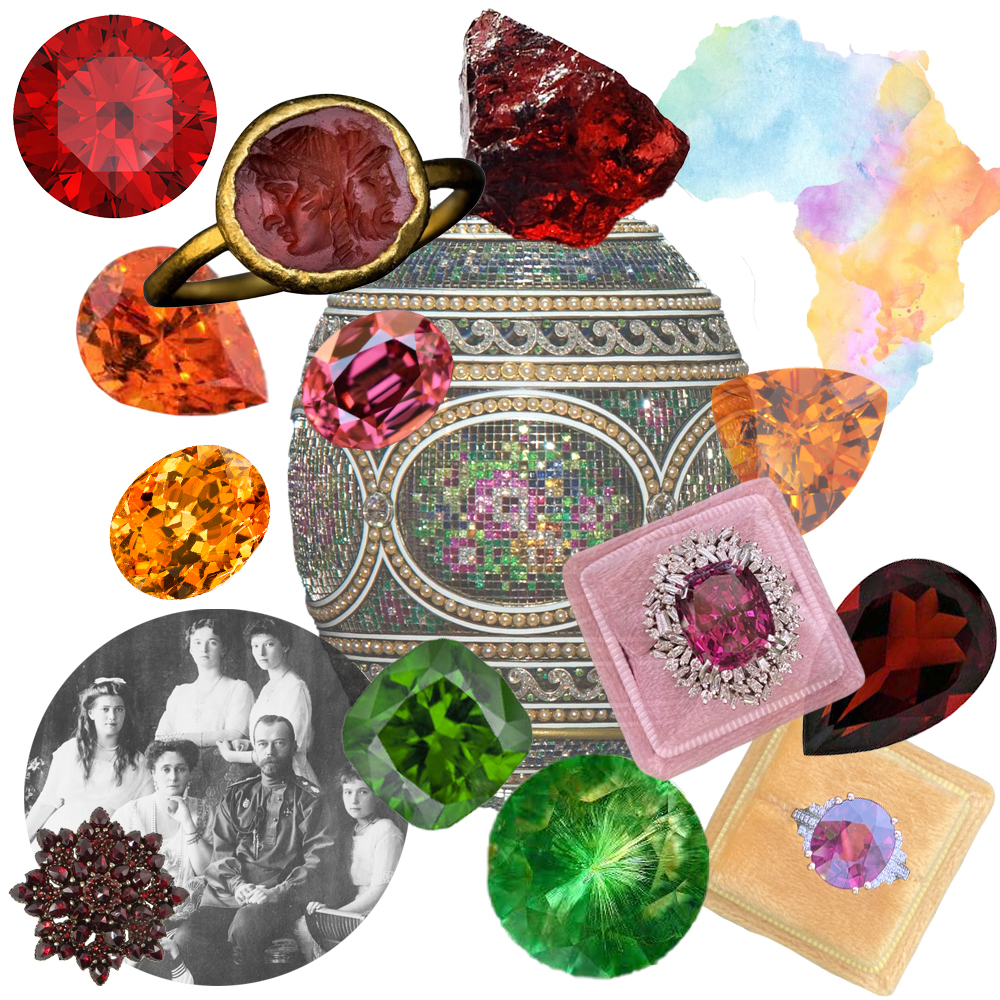
Red Garnets grace museums around the world as priceless artifacts, they’ve been buried with Egyptian pharaohs, carved in the signet rings of ancient Rome, and decorated the nobility and clergymen of the middle ages. Now, they’re just as popular as ever, especially for those with January birthdays. Red Garnets are arguably the most well-known to the public, especially since they can be sourced on almost every continent. The name Garnet is derived from the latin word for grain/seed – Granatus, likely a reference to pomegranate seeds, which can be very similar in size and colour to Garnet crystals, however, this special gem actually comes in a wide variety of highly sought-after colours, a few of which are some of Earth’s rarest minerals.
Similar to Tourmalines, Garnets are actually an entire group of minerals, (rather than a species such as corundum, which is Sapphire) so they are quite an intricate gemstone, with a large variety of chemical compositions and species. They are so complex, in fact, that many Garnets, such as the gorgeous raspberry red Rhodolite variety, are actually a combination of multiple species.
Like Diamonds and Spinels, the Garnet group quite uniquely belong to the cubic crystal system, which means their crystals form in cube-like structures and that they are singly-refractive. The latter helps some Garnet species reflect light in a way which allows them to sparkle in a stunning way, very comparable to the alluring fire of Diamonds.
Green Garnets, also known as the Tsavorite and Demantoid varieties, are some of the most valuable and sought-after green gems in the world. Demantoid Garnets were first found in Russia in the 1800s and became very popular with the Royal family as a personal favourite of Czar Nicholas II. They were also used often in the creations made by Faberge at that time. Demantoid Garnets famously owe their lovely green colour to trace amounts of Chromium, just like Emeralds. However, they also contain traces of Iron, which is what gives them their trademark yellowish tint. Demantoid Garnet’s most notable trait is their incredible dispersion, which gives them amazing fire and sparkle, similar to Diamonds. They range from yellowish to brownish green, but their most valuable colour is a true, intense green, very similar to Emerald. They are also the only gem with the potential to show “horsetail” inclusions—a fan like group of wispy inclusions, which can greatly increase their rarity and already very considerable value. Dementoid Garnets are still found in Russia, as well as Namibia, Italy, Iran, Mexico and Greece. However, their sources are far and few between, which of course ensures their prices remain incredibly high.
In contrast, Tsavorite Garnets weren’t actually discovered until the 1960s. Equally beautiful, Tsavorite Garnets get their green hue from Vanadium (also similar to some Emeralds), and can also range from a yellowish green to bluish green, with the most sought-after hues being in the bluish green to true green range. When green Garnet doesn’t possess enough saturation to be truly labelled a Tsavorite, it is sometimes referred to as a “Grossular Garnet.” While some Tsavorites are found in Pakistan, the most popular source is East Africa, including Tanzania, Kenya and Madagascar.
Both Demantoid and Tsavorite Garnets are highly rare in large, eye-clean sizes, especially over three carats. Therefore, they are most often used as small accent stones or in pave-style designs. They remain extremely valuable in any size, and are most valued for their strongly saturated colour and incredible Diamond-like sparkle.
Orange Garnets, which get their colour from Manganese and trace Iron, are known as Spessartine Garnets. Their beautiful and lively colour range is as broad as the hues of a flame: from a light yellowish-orange to bright orange, fiery red, and dark brownish red. However, the most valuable (by a mile) are those with an intense, reddish-orange hue with medium to medium-dark tone. While Spessartine Garnets used to be considered rare, collector’s only gems, new discoveries in Africa including in Nigeria, Madagascar, Namibia, Tanzania and Zambia, have made them much more accessible to the public in recent years. Other sources also include California, India, Pakistan, Sri Lanka and Brazil. While they’ve become more accessible, prices for large, high-quality stones still remain at a premium and the interest in this gorgeous and uniquely-hued stone remain high, especially since orange gemstones remain more unconventional in the gem world.
While deep red Garnets have been gracing jewellery boxes for thousands of years, we now know that not all red Garnets are created equal. For example, the finest raspberry-coloured Rhodolite Garnet can easily pass for a stunning Rubellite Tourmaline, or even Ruby. While the range of their colour can include a light reddish-purple to a deep berry red, these gems are most valuable when they have an intensely saturated hue, but are still bright and sparkle with reflected light. Garnets with areas of “extinction,” which are dark, nearly black, shadowy areas in the gemstone which aren’t able to reflect light, are common but certainly not considered the finest example of this lovely stone. These very deep red Garnets are technically a combination of the Pyrope and Almandine species, but are most commonly referred to as simply Almandine Garnets. Since they could often look so close to black, they were very popular in Victorian-style jewellery. While red Garnets were first discovered in North Carolina in the late 1800s, they are now most commonly found in East Africa, including in Tanzania and Madagascar, as well as India and Sri Lanka.
Comments Off on Katherine James Jewellery Custom Content, September 2021
Posted in Branding, Katherine James Jewellery
Tagged almandine, coloured gemstones, Custom Content, demantoid, Email Newsletter, Garnets, green garnets, Grossular garnet, jewellery, jewellery consultant, red garnets, spessartine garnet, Toronto gemolgist, tsavorite
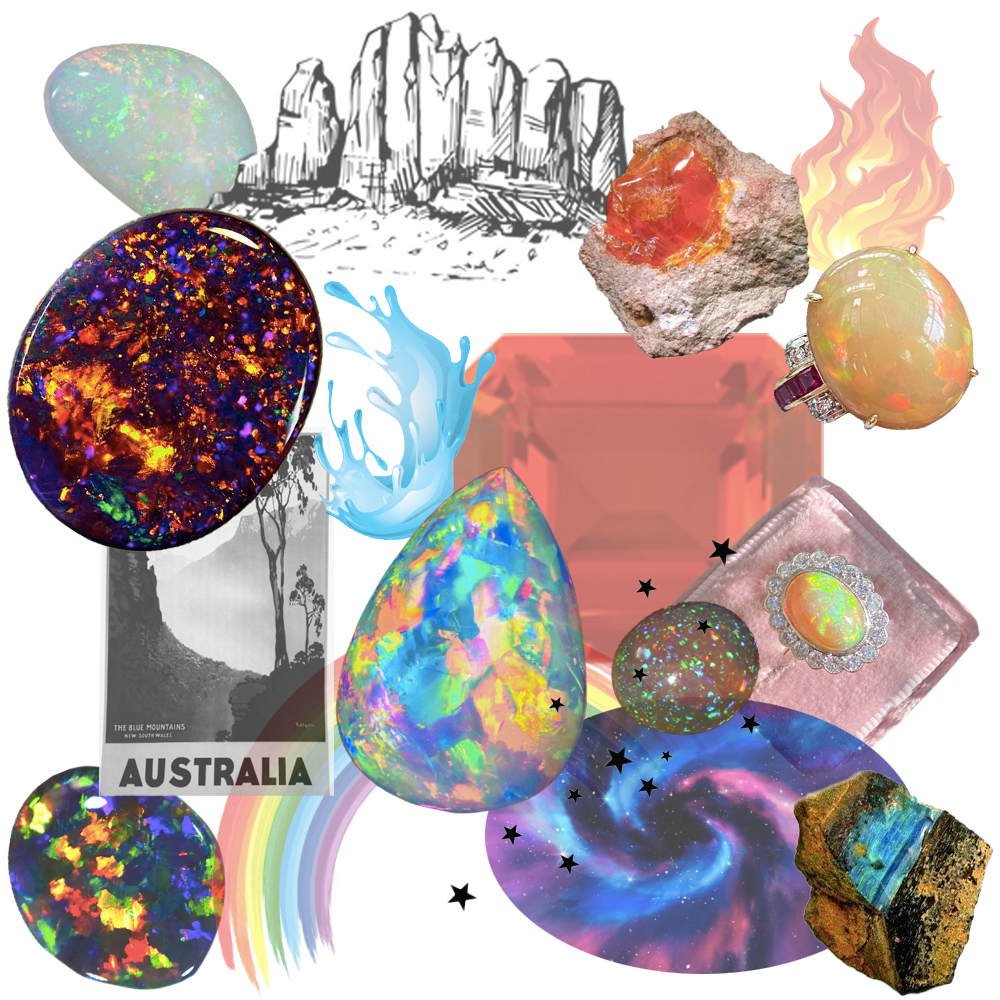
Why Opals are still one of the world’s most mysterious gemstones
There’s no question that Opals are one of the most unique gemstones on Earth. For centuries, their phenomenal qualities have been compared to some of the most majestic and mysterious entities in the world, including galaxies, volcanoes, fireworks, and of course, true love. In ancient Rome, the gem was given the name “Opalus,” meaning precious stone, and they considered this rare gem, which they were absolutely fascinated by, the pinnacle of ultimate love and hope.
“Some opali carry such a play within them that they equal the deepest and richest colors of painters. Others…simulate the flaming fire of burning sulphur…and even the bright blaze of burning oil.” –Pliny, a Roman scholar, 75 AD
Throughout history many have been convinced that the kaleidoscopic colours often seen in Opal made it the most valuable and powerful gem of all. They compared it to the power of the whole universe, since it contained the hues of every other precious stone. This phenomenal effect is referred to as an Opal’s play-of-colour and the shades displayed, as well as their pattern, can greatly affect an Opal’s value.
When it comes to value, the most important factor is how bright and vivid its play-of-colour effect is, and how well it stands out against the rest of the gem, without any cloudy or milky haziness. Next in importance, is how many different colours are displayed. An Opal which includes the entire spectrum of the rainbow is very rare, with red and orange being the most rare and desired hues, and green and blue generally considered more common. For example, even if an Opal only shows one or two colours, but displays large patches of red, it is still considered quite desirable.
An Opal’s background colour or “base colour” can also vary widely and have a huge effect on its value. White Opals with subtle play-of-colour have been the mainstream in the Western world for decades, and are surely one of the most common varieties which make up the bulk of commercial quality Opal jewellery. However, White Opal is available in excellent qualities, with the best having sharp and vivid play-of-colour with a full spectrum of colours and a crisp pattern.
Opals with very dark background colours, which appear an opaque black in reflected light, including green, blue, brown, dark grey and actual black are all considered Black Opals, and are the most prized of any specimen. Since their dark base colours are ideal for showing off vibrant play-of-colour, they’re considered the crown of the Opal world, and exceptional specimens can rival any other gem and sell of tens of thousands of pounds.
However, Opals can also have a transparent to translucent background (often referred to as “Crystal” or “Water” Opals), as well as a wide range of yellow, orange and red base colours, which are Fire Opals. Keep in mind that not every Fire Opal contains play-of-colour, but their vibrant hues, which is believed to be caused by trace iron oxide, still make them quite valuable and sought-after.
If all the colour possibilities weren’t complicated enough, Opals are also evaluated for the patterns of colour they display. This ranges from minimal phenomenon, which looks like small dots of colour and is referred to as “pinfire,” to large patches or “flashes” of play-of colour to the most desired, which is “harlequin.” Harlequin play-of-colour is the most even and well-balanced, and of course also the most rare and valuable. It shows large, near-rectangular-shaped patches of colour, which are uniform and tightly arranged, like a checkerboard or actual harlequin diamond pattern.
Play-of-colour refers to ‘precious’ Opal, but not every Opal displays this phenomena. “Potch Opal” or common Opal, are stones without play-of-colour, but can still come in a variety of beautiful colours, including Peruvian Pink and Blue Opals, and are often still used in jewellery and other fine objects.
One of the characteristics which makes Opals so unique in the gem world, is that they do not have a crystal structure. Instead, they are considered amorphous, and contain a high percentage of water. If you were to look at a precious Opal under 30000x magnification, you would see a perfect, symmetrical stack of tiny spheres made of silica, which is composed of silicone and oxygen. The uniformity of this stack of spheres is what allows light to be broken into spectral colours, which creates an Opal’s trademark rainbow play-of-colour effect. Opals that have an irregular grouping of spheres of all different sizes are common Opals, and do not display phenomenon.
Since Opals contain a lot of water, they can be prone to damage from moisture-loss. If they’re exposed or stored with excessive heat, dryness or bright light, they can suffer from crazing, which appears like a host of tiny spider web-like cracks on the surface of the gem. Instead, always store them in a dark, cool place and preferably in a silk pouch, which will not only protect them from being scratched by other jewels, but will also protect their moisture content. Since nearly all Opals are cut as cabochons to show off their play-of-colour, they must be worn with care since as a softer gem (they’re a 5.5-6 on the Mohs Hardness scale with fair to low toughness) they can be prone to damage if accidentally hit or scraped.
Overall, it is clear that Opals are a highly complex gem with one of the widest ranges of value in the gem world. Their status as a non-crystalline, phenomenal gem, which scientists are still not 100% sure how or when they were formed still makes them one of the most mysterious and alluring jewels, with a mystical history, passionate fanbase and enormous scale for value. Undoubtedly, regardless of how you take your Opals, they have an indisputable and highly revered place in any jewellery collection.
Comments Off on Katherine James Jewellery Custom Content, July 2021
Posted in Branding, Katherine James Jewellery
Tagged coloured gemstone, Custom Content, Email Newsletter, Gemologist, gemstones, jewellery, Jewellery cleaning, jewellery writer, Opal
Whether it’s a surprise or a shared decision, here’s how to choose an engagement ring which will stand the test of time.
While most people focus on the centre stone of their ring, the truth is, the setting is what will truly set the tone for your new, important jewel. Once you feel confident about the style of setting you’re looking for, everything else will fall into place. So, is your partner one for antiques or do they love sleek, contemporary looks? Keep in mind, that if they have a very active lifestyle or one that requires them to be a bit tougher on their hands, something modern (even if it’s an antique reproduction) might fit their daily life best.
If you don’t automatically know which aesthetic suits, don’t sweat it. Instead, look to the design details they’ve chosen in other parts of their life, such as their choices in furniture, tableware, other housewares, favourite clothes, etc. If they tend to love frilly, romantic details with pretty prints, florals, lots of colour and sweet touches, chances are similar details in their engagement ring will light them up. Antique styles with engraving, fanciful prongs, fancy-cut gems, and even some colour are all great features you can consider.
On the flip side, if their home, wardrobe and other favourite items look streamlined with a simple colour scheme, and modern and sophisticated details (think: colour blocking and stripes) something very refined, simple and elegant is likely more their speed. Consider a monotone colour palette, bezel settings, subtle Art Deco styles, and slick, contemporary details. Of course, these may feel like two extremes and there is plenty of room in between which can allow you to find the perfect combination of varying details which will fit your beloved to a tee.
Keep in mind, when it comes to clothing and other jewellery your partner may have, everyone likes to change it up and try new styles and looks, so these can be a bit misleading when trying to find their true personal style. An engagement ring is something they’ll potentially wear every single day, and needs to be quite classic in some ways, so it will complement their other wardrobe pieces. For the best idea, think of what their absolute favourite items of clothing are, the things they wear the most, and the stores they love to visit and even window shop at. Taking a sneaky peek at their Pinterest page, if they have one, can also be a great way to help you capture their true, overall taste.

Choosing a coloured gemstone as the centre stone or accent stones can be a really special way to make an engagement ring feel extra personal and customized to your partner and your relationship. There’s a chance they may have mentioned that this is their preference, or that a standard Diamond is not their style. Of course, that will certainly make it easier, but if not, you can consider the above style hints, again. If you partner is super classic and loves really glamourous details, an all-Diamond design might be best. If they’re more fanciful, artistic or even traditional, something with a bit of colour will likely make them feel extra special.
Birthstones are a great place to start, and again, this can be used as a centre stone or accent stones in a three-stone ring or a halo or on a band. You can also combine your birthstones for a very romantic touch, or even use the stone of the month that you met or will be engaged (or married – if you know that already!) for an extra-creative touch. Of course, if your beloved has a favourite colour, such as Pink, Yellow or Green, or always mentions how much they love a certain ring, such as the Duchess of Cambridge’s epic Blue Sapphire, that is a perfect jumping off point, as well.
Colour also extends to the metal you’ll choose for the setting. While some gems look particularly ravishing in certain metals, choose the style you think suits the above hints, once again. If you’re going for a goes-with-everything monotone look, Diamonds set in Platinum or White Gold are a no-brainer. If you’re looking for something more unique, coloured gems set in an antique Yellow Gold setting can be extra luxe and romantic looking. If you’re not sure, a setting which combines both has been a major ring trend, and will guarantee the ring will match whichever other jewellery your partner owns or will choose in future.
If you’re hoping for a proposal which is a total surprise, you may feel a bit paranoid about giving off even the slightest of hints. However, looking for important clues at this point can make all the difference, and you’ll be surprised what you can pick up on once you start trying to pay extra attention to everything your partner likes and dislikes. Your fiancé-to-be may just be dropping hints of their own which you hadn’t picked up on before! Things to pay attention to: comments they make while shopping, remarks about jewellery or rings of friends, family or celebrities, how they react to proposal or wedding scenes in movies or on TV. Making an effort to be more receptive to their comments can open up a whole new world of details for you. Also, when they do make comments, use the opportunity to ask subtle questions about the details so you can best understand what they are trying to communicate. You won’t be giving anything anyway. Also, don’t be afraid to ask questions when you’re both picking out other items, such as housewares, to understand why they like or dislike certain looks.
Friends and family can also be a great resource. If your partner is particularly close to a certain friend, cousin or sibling, they may have even shared what their ‘dream’ ring would look like. They may also help you in clarifying the personal style of your partner. Before you go down this road, just beware of sharing your secret (you may want to spare the specific details of the timeline etc.) if you’re not totally sure they won’t spill the beans. Also, they naturally may impart their own personal style when offering their opinions on various ring looks, so you many want to take their input with a grain of salt!
Lastly, it goes without saying that you don’t want to invade your partner’s privacy. However, there’s a chance they may have chosen rings they love on their Pinterest board, or even saved some pictures to a file on their computer. Investigate these avenues as much as possible without getting too personal (or caught red-handed!)
If you just can’t land on a design that makes you feel confident, don’t sweat it: you still have plenty of options. You can propose with a stand-in ring, such as one of these Moissanite options, and allow your future partner to choose their own forever piece later. Another option which can still be very meaningful, is to propose with a band, either streamlined or set with Diamonds or coloured gemstones, which he or she can still wear later as their wedding band.
When it comes to sizing the ring, you can try asking friends or family, or try to secretly trace the inner circumference of a ring your partner already owns and match it up with one of our complimentary ring sizers. As a last resort, an N ½ is one of the popular ring sizes, and nearly every ring can be re-sized later, if need be.
Just remember that many rings can take at least a couple of weeks to arrive, and custom orders can also take up to eight weeks, so plan ahead if you’re trying to meet a special date. At the end of the day, the love and sincerity behind your proposal is what will mean the most to your partner and if all else fails, any ring can be exchanged or returned at KJJ! We’re always here to help you through your decision making process, contact us here to get started.
Comments Off on Katherine James Jewellery Custom Content, May 2021
Posted in Branding, Katherine James Jewellery
Tagged coloured gemstones, Custom Content, Diamonds, Email Newsletter, engagement rings, Gemologist, jewellery consultant, jewellery editor, jewellery writer

How Amethyst evolved from an elitist status symbol to one of the world’s most popular coloured gems.
Sapphire and Tanzanite may both occur in purple, but there is no doubt that Amethyst has the market cornered when it comes to Violet-hued gemstones. In fact, its attractive colour, wide availability, and affordable price point have all helped to secure its status as one of the most popular coloured gemstones, period.
The colour purple alone has quite a rich history. It was once considered a magical occurrence that could turn heads and drop jaws. It was so obscenely difficult and expensive to recreate out of nature, that the pigment (usually made from sea mollusks) was reserved solely for the clothing dye of royal or religious figures. That all changed when a chemist accidentally created a purple pigment in 1856, which was eventually named “Mauveine.” This new invention brought Mauveine to the masses, and soon the colour purple was the must-have hue for everyone. Its popularity among the masses couldn’t even deter the who’s who of the day from wearing it. Instead, Queen Victoria and Empress Eugenie (the wife of Napoleon III) were seen wearing Mauveine dresses at major society events. But, which jewels should one wear with their new purple wardrobe? Amethysts, of course!
Coincidently, around this same time, Amethysts had their own change of fortune. Until the 19th century, Russia remained the major global source of Amethyst, making it scarce and extremely valuable, along with Diamonds, Rubies, Emeralds and Sapphires. The allure of its unique purple colour and rarity made it a focal point of religious and royal crown jewels for ages. However, in the 1800s, a massive deposit discovered in Brazil lead to Amethysts flooding the market, which caused them to lose a touch of their aura and status in the upper echelons of society. The rest of the world, however, fell in love with the unique purple stone they once could only admire from afar, and Amethysts became a major feature in Victorian-era jewels, all at the height of Mauveine madness!
The name Amethyst comes from the ancient Greek word for “not intoxicated.” Revered by the Ancient Egyptians, Greeks and Romans, the stone is said to have gotten its trademark hue from the grapes of Bacchus, God of Wine. Believing the magic stone could prevent overindulgence and intoxication, among other medicinal properties, both the Greeks and Romans placed the stones in their wine goblets before indulging, while some really posh citizens actually drank their wine from goblets made of Amethyst.
Today, Amethyst deposits can be found all over the world, including Canada, India, Mexico, Myanmar, Sri Lanka and the United States. However, the most prolific sources remain Brazil, and other parts of South America, and Zambia, and other parts of Africa. Amethyst is a quartz, made of silicone and oxygen, which grows in large, single or twinned crystals, similarly to other gem-quality quartz, including Citrine, Rose, Rock and Smoky Quartz.
Generally found in large geodes (which have a market all their own), Amethyst quartz actually gets its violet hue from trace amounts of Iron (sorry, Bacchus), which causes a colour centre in the gem. The colour centre often causes the gem to grow with a saturated purple tip, which eventually fades to colourless Rock Crystal further down the crystal. This makes gems with a vivid and strongly saturated violet-purple to reddish-purple colour the most valuable. However, more pastel and pinkish-lavender shades have also become popular in recent years, and are sometimes called Rose de France Amethysts.
Regardless of saturation, Amethysts should always be eye-clean at any size, and without any brown or greyish tint, and with an even colour saturation. They are also sometimes colour-zoned with other shades, including yellow Citrine, which is called Ametrine. Most Amethysts are heat treated to achieve their ideal hue, including green Amethysts, which rarely occur naturally and are most often the result of heat treatment in several stages.
While they may be much easier to acquire now than when they were considered the height of Royal fashion and status, Amethysts, which are the birthstone of February and also specifically represent the zodiac symbol of Aquarius (regardless of birthdate), are a stunning, much sought-after gemstone with an exclusive and unparalleled colour which continues to speak for itself.
Comments Off on Katherine James Jewellery Custom Content, January 2021
Posted in Branding, Katherine James Jewellery
Tagged Amethyst, Ametrine, citrine, coloured gemstones, Custom Content, Email Newsletter, Gemologist, jewellery, jewellery consultant, jewellery writer, purple gemstones, Victorian jewellery
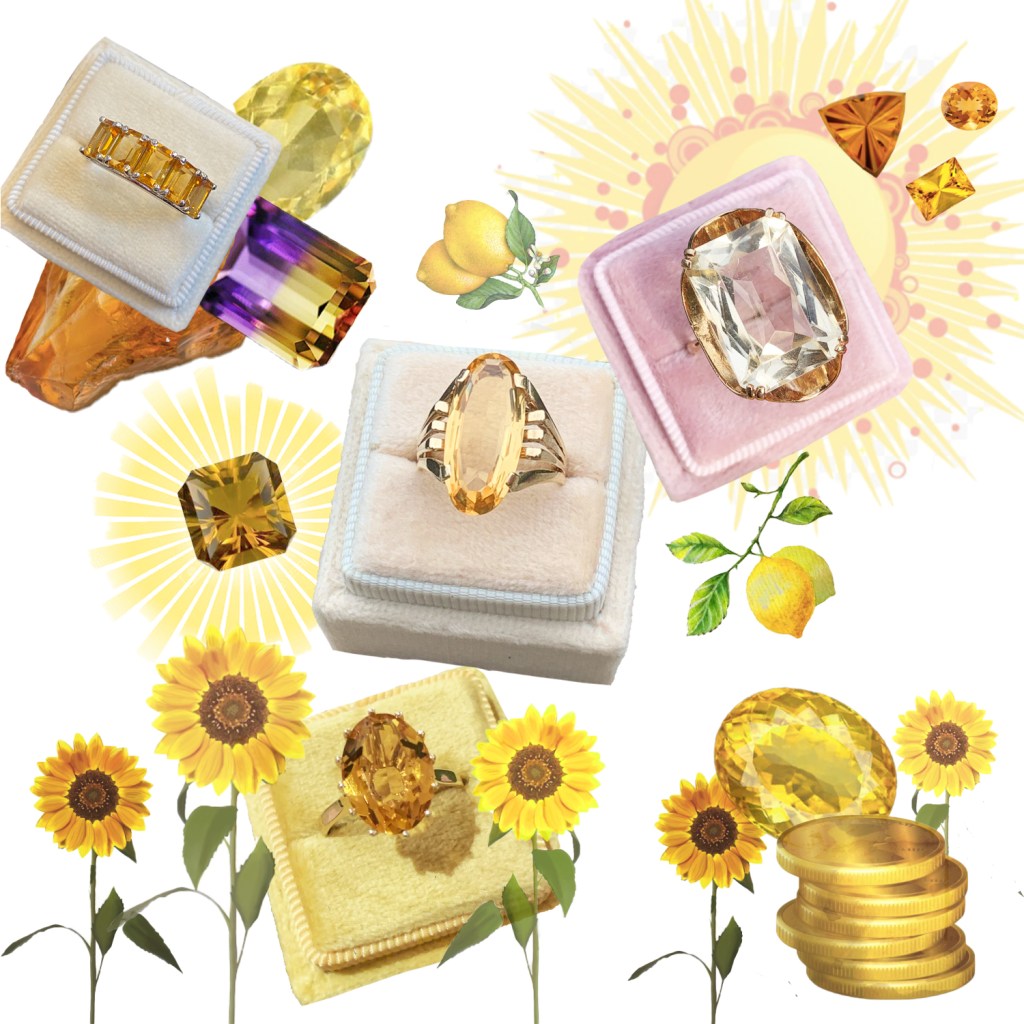
Who can resist a drop of precious, year-round sunshine?
November’s birthstone and the sunny golden child of the gem world, Citrine is a transparent yellow to brownish-orange variety of quartz. Some might consider it the peppy little sister of the most prized variety of quartz, Amethyst. However, its lively and attractive colour make it highly sought-after all its own, like a refreshing splash of lemonade on a hot summer afternoon. The top-selling yellow gem, Citrine can be an excellent alternative to both Topaz and Yellow Sapphire.
Citrine gets its trademark hue from traces of Iron. The most prized colour is a highly saturated yellow, however, its earthy shades of cognac brown and fire orange are equally popular in today’s jewellery market. Pale shades of Citrine, which sometimes have a tint of green, are also sometimes referred to as “Lemon Quartz.”
Citrine is mined in several places around the world, including Brazil, Bolivia, Spain, Madagascar and Mexico. In eastern Bolivia, close to the Brazilian border, you can find naturally bicoloured stones with colour zones of both Amethyst purple and Citrine yellow, which is appropriately called Ametrine.
Since Citrine is available in large sizes with little to no eye-visible inclusions, it remains reasonably priced even in eye-widening carat weight. This, combined with its excellent durability make it fantastic for use in head-turning cocktail rings and other statement pieces such as pendants and bracelets. Catherine, the Duchess of Cambridge, is also known to have a large Citrine ring (thought to be from her personal collection, pre-marriage), which she still wears on occasion, including to the wedding of the Duke and Duchess of Sussex.
Also a gift to celebrate thirteenth anniversaries, Citrine’s jovial hue and generous sizes symbolize joy and abundance. It became particularly popular during the second World War and in the years following with luxury houses such as Cartier, when gems such as Sapphire and Emerald became too difficult and expensive to source and transport. This certainly adds to their symbolism of being a ‘feel-good’ gem meant to embody optimism and an overall cheerful approach. They’ve also been known as the ‘Merchant’s Stone,’ since they represent prosperity and have been thought to increase business, profits and overall wealth. (Yes, please!)
Like turning your face to a warm spot of sunshine, Citrines are like an instant hit of vitamin D, jolting you (or your outfit!) with dynamic energy, delight and positivity.
Comments Off on Katherine James Jewellery Custom Content, October 2020
Posted in Branding, Katherine James Jewellery
Tagged citrine, coloured gemstones, Custom Content, Email Newsletter, jewellery history, quartz, yellow gemstones
 Megan Kirkwood
You must be logged in to post a comment.