
Tag Archives: coloured gemstones
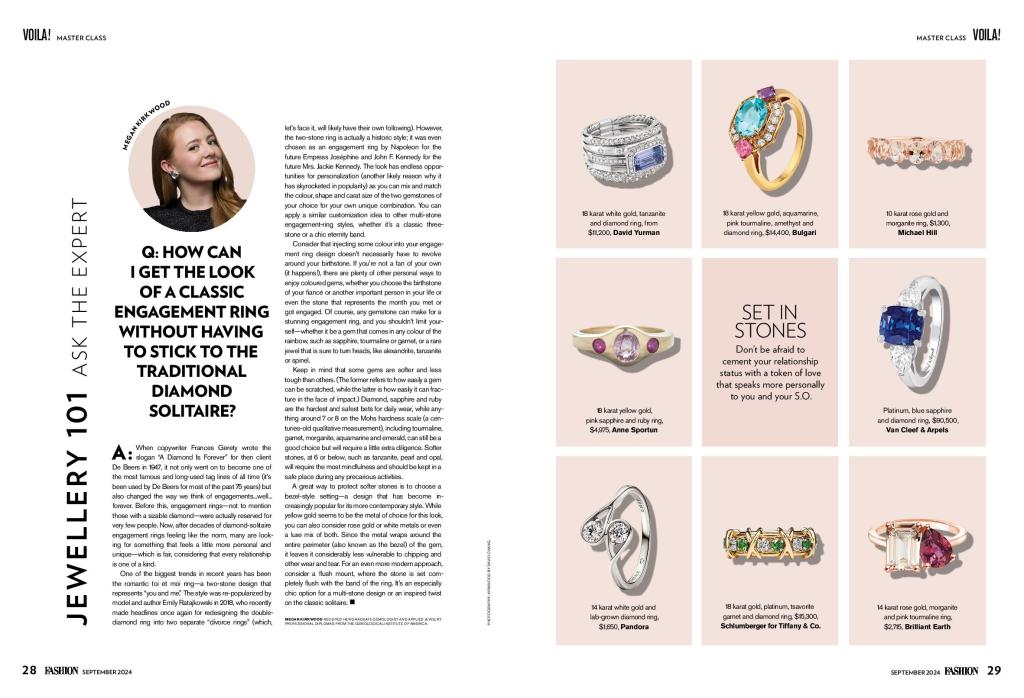
ImageFASHION, September 2024
Comments Off on FASHION, September 2024
08/02/2024 in Editorial, FASHION
Tagged aquamarine, blue sapphire ring, coloured gemstones, Diamonds, engagement rings, eternity bands, FASHION, Gemologist, jewellery, jewellery editor, jewellery expert, Jewellery trends, jewellery writer, Jewelry, Lab Diamonds, pink sapphire, ruby, tanzanite, three stone ring, toi et moi, tourmaline, tsavorite garnet, two stone ring
Katherine James Jewellery Custom Content, March 2023
Why Collectors Love Kyanite
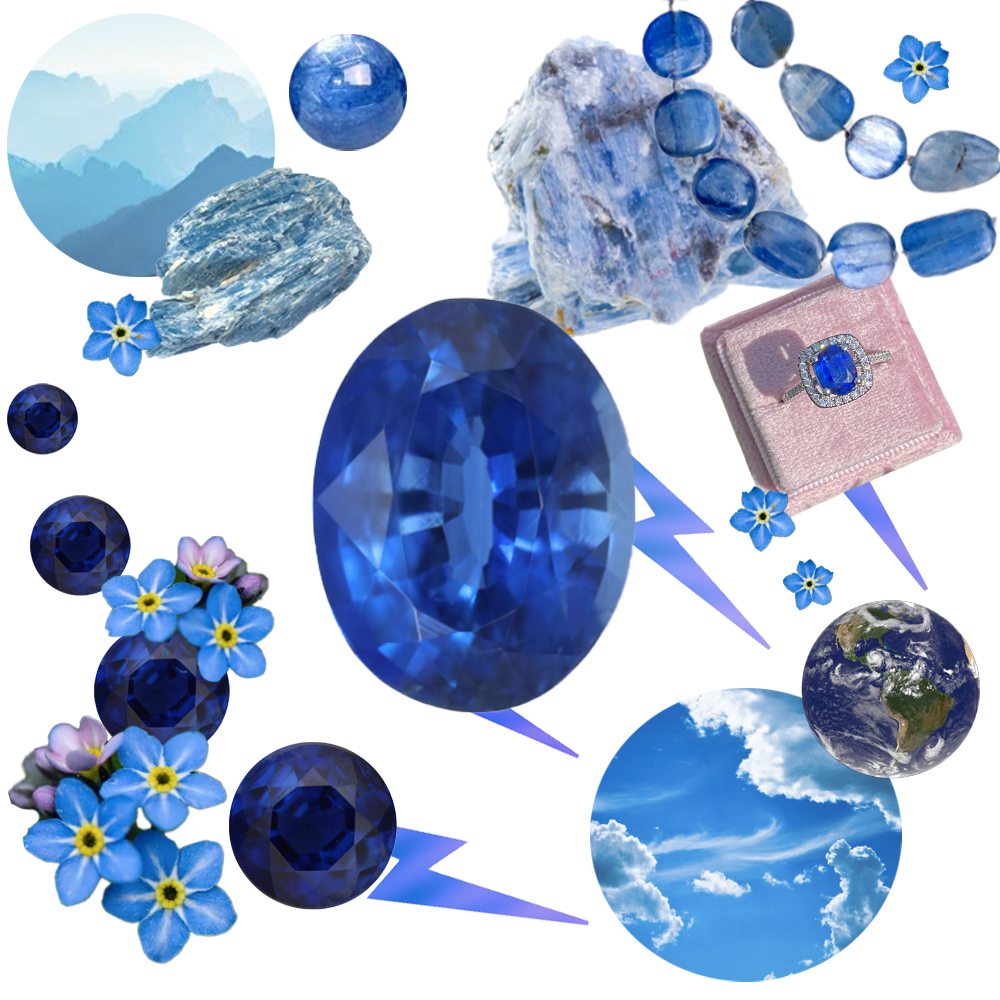
Never heard of Kyanite? You’re not alone. This gorgeous gem is a rare species and usually reserved for collectors alone. In its best qualities, it closely resembles Blue Sapphire. However, it is available in a wide range of light to dark blue colours and can also form in shades of yellow, green and brown, and, like Sapphires, can also be colourless. The name Kyanite even comes from its signature shade, as “kyanos” is the Greek word for dark blue.
Chemically, Kyanite is composed of aluminum, silicon and oxygen, which makes it a close relative of Andalusite. As is with Sapphires, Kyanite gets its beautiful blue hues from trace amounts of titanium and iron, and can sometimes display colour zoning (concentrated bands of colour) or a colour-change effect, showing a reddish to reddish violet hue under incandescent light. Kyanite is scarce, but can be found in Brazil, India, Kenya, Myanmar, Pakistan, Switzerland, Russia and the United States. While this lovely gem is not easy to find in jewellery, it does have the benefit of not often being colour treated.
One of Kyanite’s most unique traits is that it has two different hardness levels along its length and width. Along its length, it ranks at about a 5 on the Mohs hardness scale, while it is a 7 across the width of the crystal. In comparison, this range is similar to Lapis Lazuli or Turquoise through to Amethyst. While wearable everyday, it’s important to treat Kyanite with care and as the rare and delicate precious gem that it is. Avoid wearing it while being especially active, including cleaning, sports, etc. and be especially careful to avoid hard wear when showing it off in a ring. Overall, this lush blue gemstone is a highly unique jewel which is a pleasure and honour to have in your collection and a fantastic conversation piece for any jewellery lover.
Comments Off on Katherine James Jewellery Custom Content, March 2023
Posted in Branding, Katherine James Jewellery, Uncategorized
Tagged blue gemstones, coloured gemstones, Custom Content, Email Newsletter, jewellery, jewellery consultant, jewellery writer, Jewelry, Kyanite
Katherine James Jewellery Custom Content, March 2023

How to Evaluate Coloured Gemstones like a Gemologist
The process of evaluating Diamonds and coloured gemstones are worlds apart. For example, when experts examine Diamonds they are primarily looking for how well they reflect and refract light, which leads to their trademark brilliance and sparkle. This is why a Diamond’s cut is often considered its most important value factor. However, when grading nearly every other type of gem, it’s their colour that makes them special, and therefore their colour which is considered their most important and value-enhancing characteristic.
Grading colour in a gem is divided into three categories: hue, tone and saturation.
Hue
Hue is simply the dominant colour that appears to your eye and where it falls on the colour wheel. For example, a Ruby may be graded a “very slightly purplish red” or a Sapphire could be listed as “violetish blue.”
Tone
Tone is considered the degree of lightness or darkness of a colour. If you imagine a scale of white to black with all shades of light to dark grey in the middle, where on that scale would the gem fall? Tone can be described as any of the following, and can also be designated by number: very light (2), light (3), medium light (4), medium (5), medium dark (6), dark (7) or very dark (8). The best tone for most gems is considered in the 5-6 range or medium to medium dark.
Saturation
Saturation is considered the strength or intensity of a gem’s colour and is perhaps the most important colour factor considering personal taste for various hues and tones can vary widely. When judging warm colours, including yellow, orange and red, you’ll want to consider how “pure” the colour of the gem is, or whether it has any brownish tint, and if so, how strong that tint is. When considering cool colours, such as blue, green and violet, you’ll be looking for a greyish tint, instead. Saturation can be described as any of the following, and can also be designated by number: brownish/greyish (1), slightly brownish/greyish (2), very slightly brownish/greyish (3), moderately strong (4), strong (5), and vivid (6). The best saturation for gems is considered in the 4-6 range or moderately strong to vivid.
Cut
Diamonds are often laser-cut with extreme precision in order to achieve perfect proportions that will lead to ideal brilliance and sparkle. However, coloured stones are often cut by hand and are done so in order to best show off their colour. Since a gem’s colour can vary drastically from stone to stone within the same species (and sometimes even within the same gem) cutters will sometimes vary proportions in order for a gem’s face up colour to be as ideal as possible. For example, a dark stone will benefit from a shallower cut, which will allow more light into the stone and give it a brighter appearance. On the flip side, a light stone cut with deeper proportions will intensify the face up appearance of its colour. The latter is especially common with coloured Diamonds.
While coloured stones are naturally far less brilliant than Diamonds, it’s favourable for them to still have as much light reflection as possible. At least 25% of the surface of the gem should reflect flashes of light back to you when you tilt or rotate it under a direct light source. Good stones will have 40-60% light return, very good stones 60-75% and excellent stones will have over 75%. Areas that do not reflect light are known as light leakage, and will either be dark with “extinction” or nearly transparent with a “window.”
Proportions and Finish
As noted above, cutting proportions are not nearly as strict when it comes to coloured gems. However, the most important factors to look for in a coloured gem include an overall eye-pleasing effect, which includes a symmetrical shape, even sides and corners and a smooth, polished surface with sharp-looking, aligned facets.
Clarity
Some coloured gems are naturally more included than others, which is due in part to how their crystals form in the Earth and sometimes how they’re mined, as well. When judging coloured stones for clarity (including their lack of natural inclusions) it’s important to consider which of three clarity types they fall into. For example, as a Type III, it’s expected that a “slightly included” Emerald will have a much lower clarity level than a “slightly included” Aquamarine, which is a Type I. The following are how some of the most common coloured gems are judged for clarity, taking their natural and typical form into account:
TYPE I (typically eye clean or slightly included): Aquamarine, Blue Topaz, Green Tourmaline, Blue Zircon, Kunzite, Morganite, Tanzanite
TYPE II (typically slightly to moderately included): Alexandrite, Sapphire, Ruby, Garnet, Iolite, Peridot, Fire Opal, Amethyst, Spinel, Pink Topaz, Pink Tourmaline
TYPE III (typically slightly included to severely included): Emerald, Red Beryl, Watermelon Tourmaline
Comments Off on Katherine James Jewellery Custom Content, March 2023
Posted in Branding, Katherine James Jewellery
Tagged coloured gemstones, Custom Content, Email Newsletter, gem expert, Gemologist, GIA Gemologist, jewellery, Jewelry
Katherine James Jewellery Custom Content, December 2022
Stellar Spinel
This little-known gem has been mistaken for Ruby for centuries but is a truly special treasure in its own right.
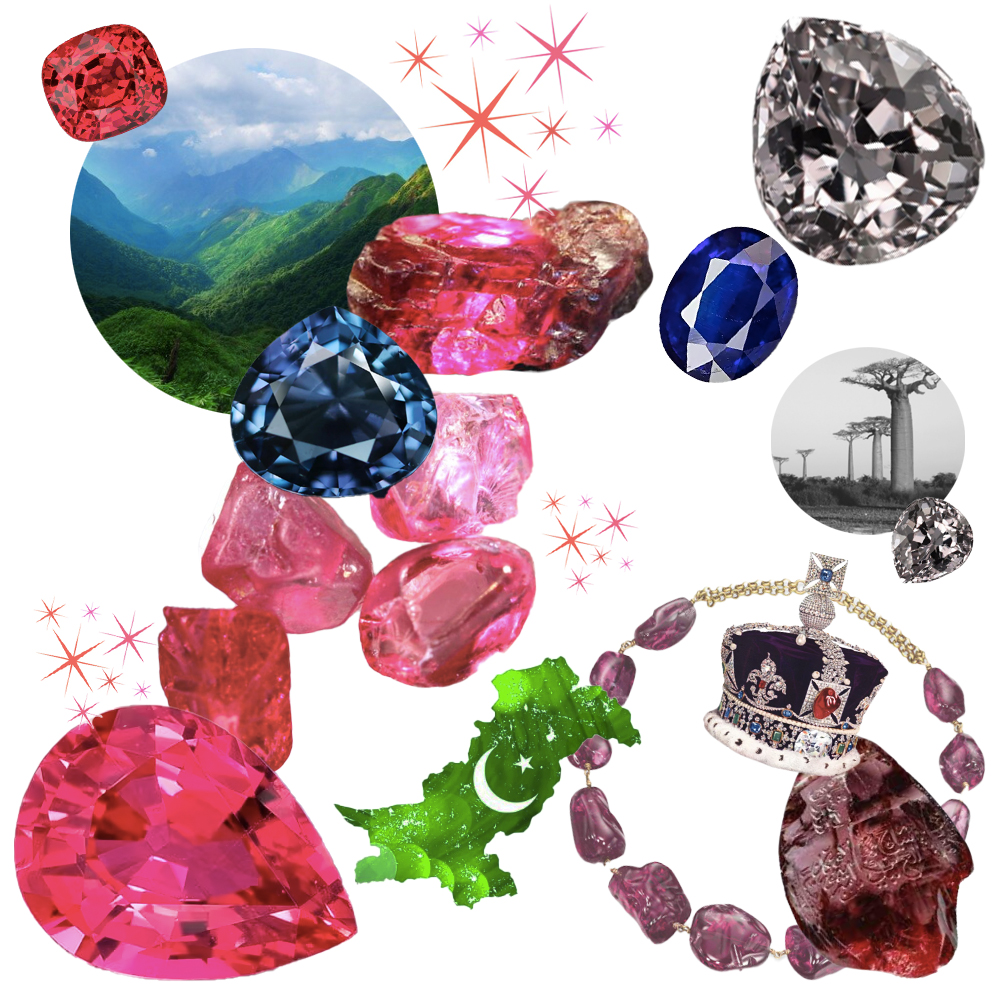
Spinel is such an intriguing gemstone, which has managed to be both strongly undervalued and fly under the radar for decades. Even some of the most famous Spinels in the world, including the Timur Ruby, which is over 350 carats, and the Black Prince’s Ruby, which sits atop the Imperial State Crown, were thought to be Rubies for most of their life. Spinel wasn’t even classified as its own mineral species until the 1800s—before then it was simply known as “Balas Ruby.”
One of the most special attributes of gem-quality Spinel is that it’s part of the cubic crystal system, along with Diamond and Garnet. This means its singly refractive and can exhibit wonderful light reflection and sparkle. Similarly to Garnet, Spinel has the immense benefits of often growing in large crystal sizes with strong, saturated colours and relatively few inclusions. In fact, they can be so naturally perfect that they are often included in jewellery designs without even being cut or polished first. Spinel also comes in a wide variety of lush colours, including intense blue, green, violet, grey, orange, pink, and of course, red.
Red and Pink Spinel are some of the most valuable and many are found in the same metamorphic deposits as Ruby, including Myanmar and Vietnam, where they famously grow in marble. Their strong hues are also caused by the same ultra-rare trace element—chromium. Blue Spinel is created by trace amounts of iron, however iron alone tends to create greyish-blue hues. For Blue Spinel to have bright, saturated colours that can compete with Sapphire, traces of cobalt with lower iron content tend to be preferred. These stones are often sought-after in similar sources to Sapphire, including Sri Lanka, Madagascar, and Pakistan. Also, similar to Sapphire, it’s possible to find both Star Spinel and colour-change Spinel, however they are much less common.
Since Spinel is still not widely known about, it can offer amazing value benefits. While a bright red Spinel might easily be mistaken for Ruby in both colour and quality, a sizeable carat weight will often sell for a fraction of the price as a Ruby of the same size. However, highly saturated, nearly neon-coloured Pink Spinel is slowly becoming more in-demand, and its rarity has made it more expensive. Some Pink, Red and Blue Spinel can sometimes be treated to improve their colour, however most Spinel are generally left untreated.
Overall, this bright and sparkling gem, which is also considered a birthstone for August, offers incredible attributes for such a little-known variety and is a delightful choice you’ll never regret.
Comments Off on Katherine James Jewellery Custom Content, December 2022
Posted in Branding, Katherine James Jewellery
Tagged coloured gemstones, Custom Content, Email Newsletter, jewellery, jewellery consultant, jewellery writing, spinel
Penwarden Fine Jewellery Email Newsletter, June 2022


Comments Off on Penwarden Fine Jewellery Email Newsletter, June 2022
Posted in Branding, Penwarden Fine Jewellery
Tagged coloured gemstones, Diamonds, Email Newsletter, eternity bands, jewellery, Jewellery trends, Jewelry, rings, wedding rings
Penwarden Fine Jewellery Email Newsletter, June 2022


Comments Off on Penwarden Fine Jewellery Email Newsletter, June 2022
Posted in Branding, Penwarden Fine Jewellery
Tagged coloured gemstones, Diamonds, Email Newsletter, gold, jewellery, Jewellery cleaning, Jewelry, Pearls, platinum, Silver
Katherine James Jewellery Custom Content, May 2022
What are Ceylon Sapphires?
The island of Sri Lanka continues to be one of the world’s most important sources of Blue and Fancy-Coloured Sapphires.
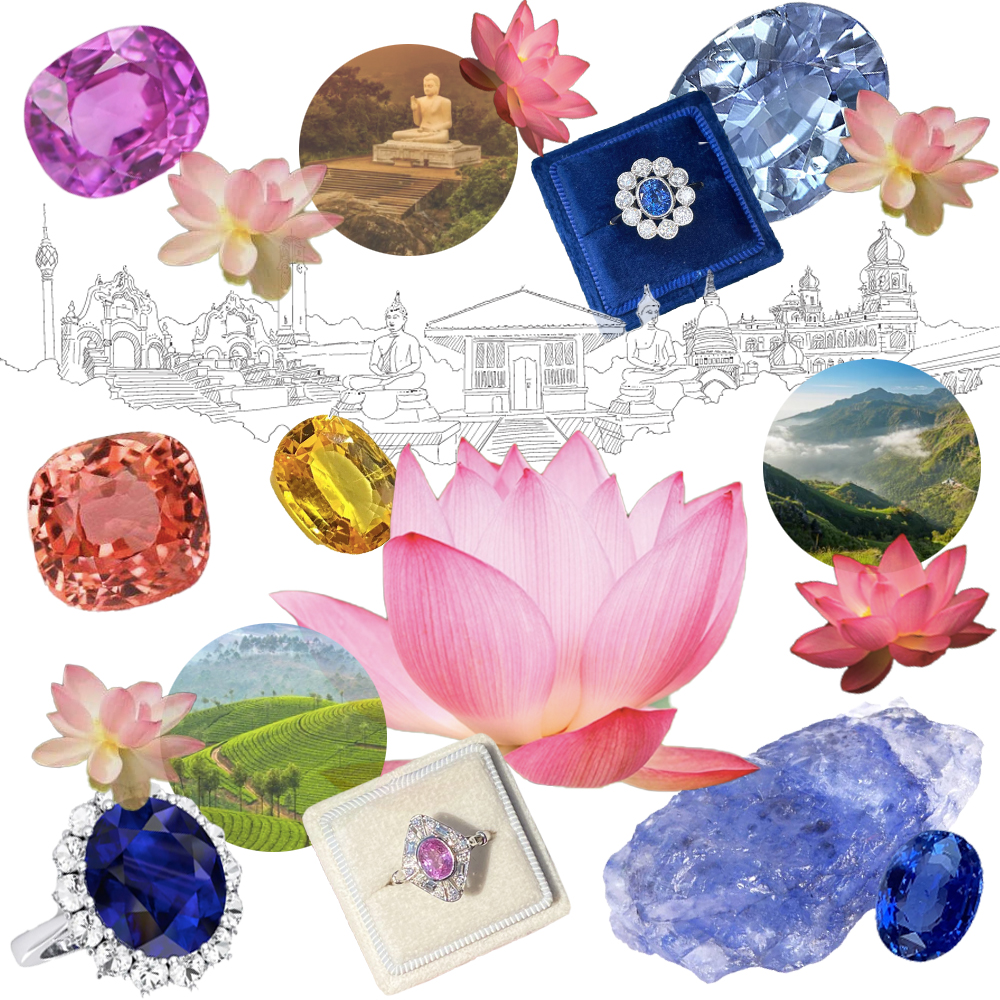
Sri Lanka, Island of Gems
Ceylon is an old name for the South Asian island now known as Sri Lanka. Located in the Indian Ocean, Sri Lanka is a small pear-shaped country with a population of approximately 22 million people. It’s a primarily Buddhist nation with a rich cultural heritage which includes being part of the ancient Silk Road. Extraordinarily, it has long been known as the “island of gems,” as it enjoys ideal geological conditions that has led to it being incredibly abundant in high quality jewels. In fact, the island is one of the world’s richest concentrations of gems, including 40 different mineral species.
Source is important when it comes to gemstones because it can add historical context, the idea of scarcity, and the specific geological conditions of each location often affect the most important characteristic of a jewel, which is colour. Since Sapphires are found in more places in the world that the rest of the “big three,” which also includes Emeralds and Rubies, you’ll sometimes see source listed with Sapphires more often as a way of distinguishing their value, as well as describing their colour.
500 to 600 years ago, Sri Lanka was actually located in the middle of an ancient supercontinent. While seemingly the plot of a movie, this true slice of its history means that millions of years ago, perfect levels of pressure and heat ensured Sri Lanka would be rich in metamorphic gems for millions of years. Due to erosion, most of Sri Lanka’s gems are found in alluvial deposits, which refers to locations that are away from their original rock formation, such as riverbeds and streams.
What makes Ceylon Sapphires so special?
Sri Lanka has been supplying the world with fine quality Sapphires for over 2000 years, and some historians believe it is actually the world’s very first source of Blue Sapphire on earth. Along with Kashmir (which is no longer in operation) and Myanmar (also referred to as Burma), Sri Lanka is known for producing some of the world’s finest qualities of Sapphires in every colour. (A certain famous Blue Sapphire and Diamond halo engagement ring features a 12 carat Blue Ceylon Sapphire.)
Similar to Rubies, Sapphires that are sourced from metamorphic rock tend to be the most prized because their environments are low in Iron, which allows the gems to maintain a vibrant, bright hue. Iron is generally more prolific in basalt rock conditions, such as those in Australia, and tends to give Sapphires a darker tone and greenish tint.
Which colours are Ceylon Sapphires available in?
While gemstones can vary in tone and colour regardless of where they’re sourced, Blue Ceylon Sapphires are generally thought of as having an ideal violet-blue to blue colour, often referred to as “cornflower blue,” which is lighter and brighter than most. Any Sapphire which isn’t blue is considered a “fancy-coloured Sapphire” in the trade and Sri Lanka is famously considered a producer of the widest range of fancy colours in the world, including top quality Yellow, Pink and Purple varieties. It is particularly famous for Star Sapphires and Padparadscha Sapphires, a pinky-orange variety which gets its name in part from the Sinhalese word for lotus flower.
While there are tests that can be performed by a gemologist and organizations such as the GIA to determine the geographic source of a gem, keep in mind that one of the many unique traits of coloured stones versus Diamonds is how they are mined. Coloured gems are often sourced in a much more independent and artisanal manner, versus having large corporate structures behind them which track their every move. So, by their very nature, coloured gems, including Sapphires of every colour, tend to pass through many hands, sometimes even in border towns, and pinpointing the exact, original source can be tough for anyone to 100% guarantee. While geographic terms need to be used as accurately as possible, it’s important not to lean on them too heavily, and instead, use them to further inspire your love of jewellery, its history, and the stunning variety of colours they possess.
Comments Off on Katherine James Jewellery Custom Content, May 2022
Posted in Branding, Katherine James Jewellery
Tagged ceylon sapphires, coloured gemstones, Custom Content, Email Newsletter, Gemologist, GIA, jewellery consultant, jewellery history, jewellery writer, padparadscha sapphire, sapphires, Sri Lanka
Penwarden Fine Jewellery Email Newsletter, May 2022


Comments Off on Penwarden Fine Jewellery Email Newsletter, May 2022
Posted in Branding, Penwarden Fine Jewellery
Tagged birthstones, coloured gemstones, Email Newsletter, emeralds, jewellery, jewellery history, Jewelry
Penwarden Fine Jewellery Email Newsletter, May 2022

Comments Off on Penwarden Fine Jewellery Email Newsletter, May 2022
Posted in Branding, Penwarden Fine Jewellery
Tagged coloured gemstones, diamond shapes, Email Newsletter, Gemstone Shapes, jewellery, Jewelry
Katherine James Jewellery Custom Content, March 2022

Coming Up Roses
You may not be too familiar with these stunning pink gemstones just yet, but there’s no doubt they are the perfect jewels to add some history and romance to your collection.
What is Kunzite?
Kunzite is one of three varieties of the mineral Spodumene—but the only one you’ll likely every find in a piece of jewellery. Its unique name comes from the well-known gemologist George Frederick Kunz (who famously worked for Tiffany & Co.), and discovered a large deposit of the mineral in California in 1902.
Kunzite is a stunning gem that is found in light pink to violet hues. While watercolour-like colours are beautiful (and currently quite popular), in general, the more intense the saturation of this gem, the more valuable and prized it is.
Kunzite is most often mined in Afghanistan, Madagascar, Brazil and the U.S. state of California. Fine qualities of Kunzite remain quite rare, and even though it is highly valued by both gem collectors and jewellery designers, its low supply levels make it quite uncommon, and therefore still relatively unknown to many.
Kunzite is sometimes heat treated to improve it’s rosy colour, however keep in mind that regardless of whether it’s been treated or not, Kunzite has the very unique trait of sometimes fading when exposed to high heat or extreme light, so be cognizant of how you are storing these jewels when you’re not wearing them. It also rates a 6.5-7 on the Mohs Hardness Scale and has cleavage in two directions, meaning it has the potential to chip or split if it were to suffer a hard hit. However, mindful care and a well-made and protective setting can ensure this lovely gem stays in optimal condition for a lifetime.
What is Morganite?
Spodumene is often compared to Beryl, because they naturally occur in similar colours. Similar to Kunzite, Morganite is a rosy pink gemstone, which is a variety of Beryl (along with Emerald and Aquamarine.) These two gems also share similar origin stories when it comes to their namesake, and were even discovered around the same time. Morganite was actually named after another American gem enthusiast, and colleague of George Kunz, J.P. Morgan. Morgan, of course, was a famous financier with a love of mineral collecting, and in 1910, Kunz actually bestowed the name Morganite on this rosy mineral.
Finding Morganite, which gets its pink colour from manganese, in highly saturated hues is very rare, but it can vary from a light pink, to more salmon, peach and orangey colours, as well. In these combinations, it can even look similar to Padparadscha Sapphires. Similar to Kunzite, heat treatment is often used to intensify Morganite’s colour, and sometimes nix any yellow or orange tint. Unlike Kunzite, Morganite’s colour is stable and has no risk of fading when exposed to UV light or heat.
Some of the best Morganite on the market is known to come from Madagascar, though these specimens are now seldom available. Other major sources include Brazil, Mozambique, Namibia and the U.S. Similar to Aquamarine, Morganites grow in pegmatites, and can be found in excellent transparency and in very large crystal sizes. This makes them an especially good fit for cocktail rings, and excellent value for your money regardless of how you choose to include them in your jewellery collection. Of course, their beautifully romantic colours also make both of these unique and uncommon gemstones a lovely and thoughtful choice for engagement and anniversary rings and gifts.
Comments Off on Katherine James Jewellery Custom Content, March 2022
Posted in Branding, Katherine James Jewellery
Tagged coloured gemstones, Email Newsletter, engagement rings, George Kunz, jewellery, jewellery expert, jewellery writer, JP Morgan, Kunzite, Morganite, pink gemstones, romantic gemstones
 Megan Kirkwood
You must be logged in to post a comment.