Posted on03/26/2023|Comments Off on Katherine James Jewellery Custom Content, March 2023
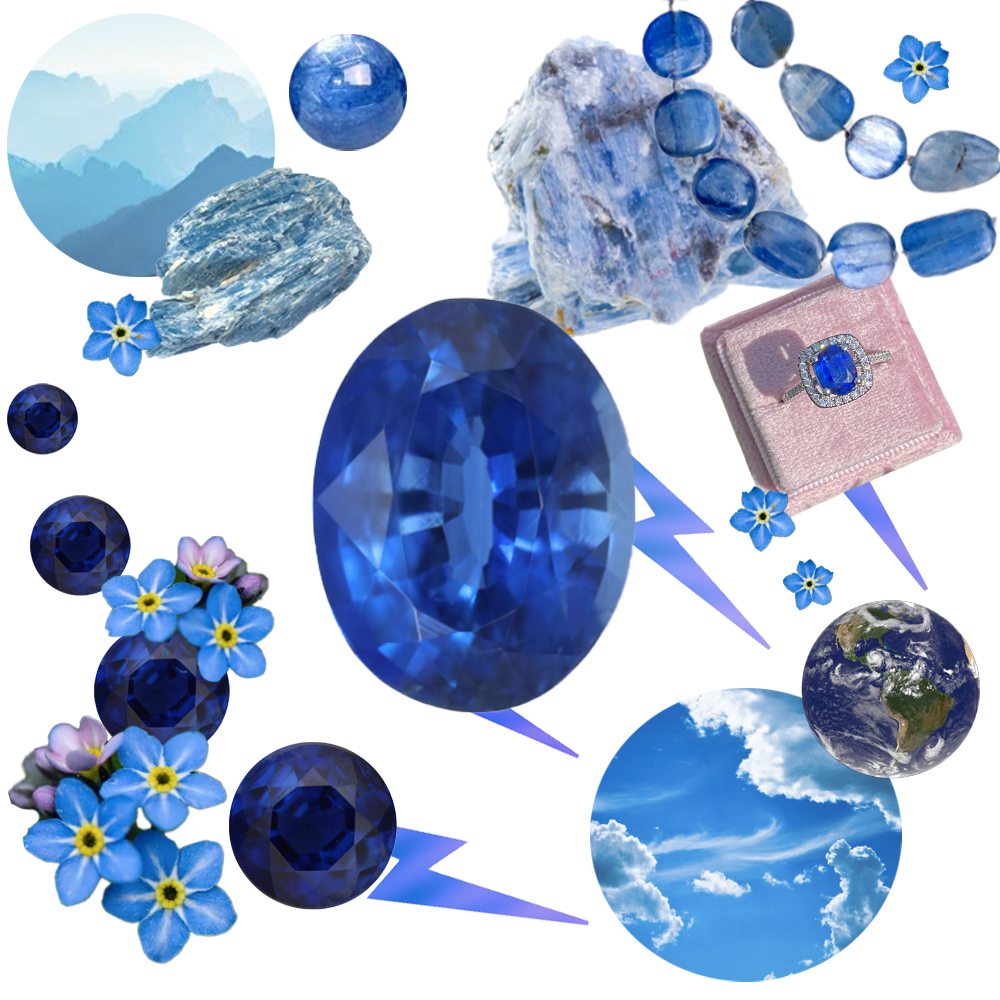
Why Collectors Love Kyanite
Never heard of Kyanite? You’re not alone. This gorgeous gem is a rare species and usually reserved for collectors alone. In its best qualities, it closely resembles Blue Sapphire. However, it is available in a wide range of light to dark blue colours and can also form in shades of yellow, green and brown, and, like Sapphires, can also be colourless. The name Kyanite even comes from its signature shade, as “kyanos” is the Greek word for dark blue.
Chemically, Kyanite is composed of aluminum, silicon and oxygen, which makes it a close relative of Andalusite. As is with Sapphires, Kyanite gets its beautiful blue hues from trace amounts of titanium and iron, and can sometimes display colour zoning (concentrated bands of colour) or a colour-change effect, showing a reddish to reddish violet hue under incandescent light. Kyanite is scarce, but can be found in Brazil, India, Kenya, Myanmar, Pakistan, Switzerland, Russia and the United States. While this lovely gem is not easy to find in jewellery, it does have the benefit of not often being colour treated.
One of Kyanite’s most unique traits is that it has two different hardness levels along its length and width. Along its length, it ranks at about a 5 on the Mohs hardness scale, while it is a 7 across the width of the crystal. In comparison, this range is similar to Lapis Lazuli or Turquoise through to Amethyst. While wearable everyday, it’s important to treat Kyanite with care and as the rare and delicate precious gem that it is. Avoid wearing it while being especially active, including cleaning, sports, etc. and be especially careful to avoid hard wear when showing it off in a ring. Overall, this lush blue gemstone is a highly unique jewel which is a pleasure and honour to have in your collection and a fantastic conversation piece for any jewellery lover.
Comments Off on Katherine James Jewellery Custom Content, March 2023
Posted on03/15/2023|Comments Off on Katherine James Jewellery Custom Content, March 2023
How to Evaluate Coloured Gemstones like a Gemologist
The process of evaluating Diamonds and coloured gemstones are worlds apart. For example, when experts examine Diamonds they are primarily looking for how well they reflect and refract light, which leads to their trademark brilliance and sparkle. This is why a Diamond’s cut is often considered its most important value factor. However, when grading nearly every other type of gem, it’s their colour that makes them special, and therefore their colour which is considered their most important and value-enhancing characteristic.
Grading colour in a gem is divided into three categories: hue, tone and saturation.
Hue
Hue is simply the dominant colour that appears to your eye and where it falls on the colour wheel. For example, a Ruby may be graded a “very slightly purplish red” or a Sapphire could be listed as “violetish blue.”
Tone
Tone is considered the degree of lightness or darkness of a colour. If you imagine a scale of white to black with all shades of light to dark grey in the middle, where on that scale would the gem fall? Tone can be described as any of the following, and can also be designated by number: very light (2), light (3), medium light (4), medium (5), medium dark (6), dark (7) or very dark (8). The best tone for most gems is considered in the 5-6 range or medium to medium dark.
Saturation
Saturation is considered the strength or intensity of a gem’s colour and is perhaps the most important colour factor considering personal taste for various hues and tones can vary widely. When judging warm colours, including yellow, orange and red, you’ll want to consider how “pure” the colour of the gem is, or whether it has any brownish tint, and if so, how strong that tint is. When considering cool colours, such as blue, green and violet, you’ll be looking for a greyish tint, instead. Saturation can be described as any of the following, and can also be designated by number: brownish/greyish (1), slightly brownish/greyish (2), very slightly brownish/greyish (3), moderately strong (4), strong (5), and vivid (6). The best saturation for gems is considered in the 4-6 range or moderately strong to vivid.
Cut
Diamonds are often laser-cut with extreme precision in order to achieve perfect proportions that will lead to ideal brilliance and sparkle. However, coloured stones are often cut by hand and are done so in order to best show off their colour. Since a gem’s colour can vary drastically from stone to stone within the same species (and sometimes even within the same gem) cutters will sometimes vary proportions in order for a gem’s face up colour to be as ideal as possible. For example, a dark stone will benefit from a shallower cut, which will allow more light into the stone and give it a brighter appearance. On the flip side, a light stone cut with deeper proportions will intensify the face up appearance of its colour. The latter is especially common with coloured Diamonds.
While coloured stones are naturally far less brilliant than Diamonds, it’s favourable for them to still have as much light reflection as possible. At least 25% of the surface of the gem should reflect flashes of light back to you when you tilt or rotate it under a direct light source. Good stones will have 40-60% light return, very good stones 60-75% and excellent stones will have over 75%. Areas that do not reflect light are known as light leakage, and will either be dark with “extinction” or nearly transparent with a “window.”
Proportions and Finish
As noted above, cutting proportions are not nearly as strict when it comes to coloured gems. However, the most important factors to look for in a coloured gem include an overall eye-pleasing effect, which includes a symmetrical shape, even sides and corners and a smooth, polished surface with sharp-looking, aligned facets.
Clarity
Some coloured gems are naturally more included than others, which is due in part to how their crystals form in the Earth and sometimes how they’re mined, as well. When judging coloured stones for clarity (including their lack of natural inclusions) it’s important to consider which of three clarity types they fall into. For example, as a Type III, it’s expected that a “slightly included” Emerald will have a much lower clarity level than a “slightly included” Aquamarine, which is a Type I. The following are how some of the most common coloured gems are judged for clarity, taking their natural and typical form into account:
TYPE I (typically eye clean or slightly included): Aquamarine, Blue Topaz, Green Tourmaline, Blue Zircon, Kunzite, Morganite, Tanzanite
TYPE II (typically slightly to moderately included): Alexandrite, Sapphire, Ruby, Garnet, Iolite, Peridot, Fire Opal, Amethyst, Spinel, Pink Topaz, Pink Tourmaline
TYPE III (typically slightly included to severely included): Emerald, Red Beryl, Watermelon Tourmaline
Comments Off on Katherine James Jewellery Custom Content, March 2023
Posted on12/06/2022|Comments Off on Katherine James Jewellery Custom Content, December 2022
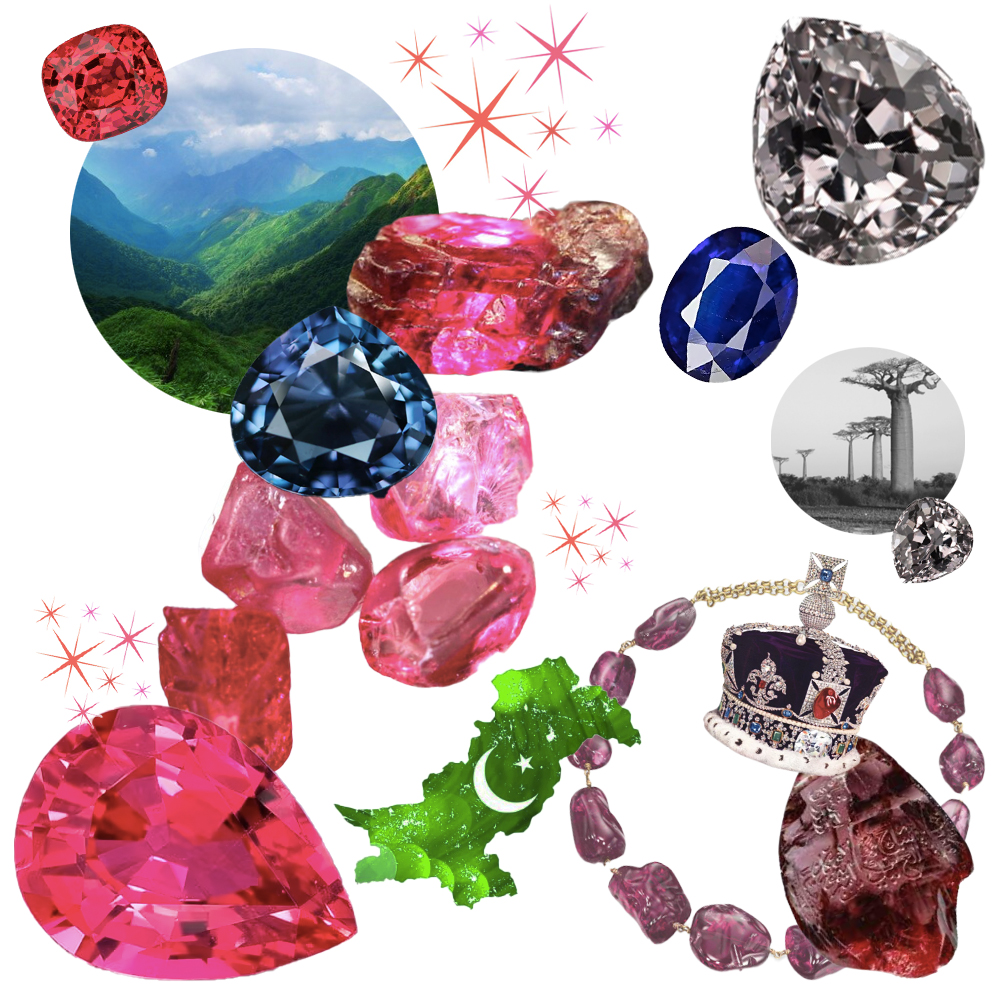
Stellar Spinel
This little-known gem has been mistaken for Ruby for centuries but is a truly special treasure in its own right.
Spinel is such an intriguing gemstone, which has managed to be both strongly undervalued and fly under the radar for decades. Even some of the most famous Spinels in the world, including the Timur Ruby, which is over 350 carats, and the Black Prince’s Ruby, which sits atop the Imperial State Crown, were thought to be Rubies for most of their life. Spinel wasn’t even classified as its own mineral species until the 1800s—before then it was simply known as “Balas Ruby.”
One of the most special attributes of gem-quality Spinel is that it’s part of the cubic crystal system, along with Diamond and Garnet. This means its singly refractive and can exhibit wonderful light reflection and sparkle. Similarly to Garnet, Spinel has the immense benefits of often growing in large crystal sizes with strong, saturated colours and relatively few inclusions. In fact, they can be so naturally perfect that they are often included in jewellery designs without even being cut or polished first. Spinel also comes in a wide variety of lush colours, including intense blue, green, violet, grey, orange, pink, and of course, red.
Red and Pink Spinel are some of the most valuable and many are found in the same metamorphic deposits as Ruby, including Myanmar and Vietnam, where they famously grow in marble. Their strong hues are also caused by the same ultra-rare trace element—chromium. Blue Spinel is created by trace amounts of iron, however iron alone tends to create greyish-blue hues. For Blue Spinel to have bright, saturated colours that can compete with Sapphire, traces of cobalt with lower iron content tend to be preferred. These stones are often sought-after in similar sources to Sapphire, including Sri Lanka, Madagascar, and Pakistan. Also, similar to Sapphire, it’s possible to find both Star Spinel and colour-change Spinel, however they are much less common.
Since Spinel is still not widely known about, it can offer amazing value benefits. While a bright red Spinel might easily be mistaken for Ruby in both colour and quality, a sizeable carat weight will often sell for a fraction of the price as a Ruby of the same size. However, highly saturated, nearly neon-coloured Pink Spinel is slowly becoming more in-demand, and its rarity has made it more expensive. Some Pink, Red and Blue Spinel can sometimes be treated to improve their colour, however most Spinel are generally left untreated.
Overall, this bright and sparkling gem, which is also considered a birthstone for August, offers incredible attributes for such a little-known variety and is a delightful choice you’ll never regret.
Comments Off on Katherine James Jewellery Custom Content, December 2022
Posted on06/02/2022|Comments Off on Katherine James Jewellery Custom Content, June 2022
The Magic of Moonstone
While Moonstone may sound like something that’s found in space (or at least in a meteorite) it’s actually the most well-known member of the feldspar mineral family, which also includes Amazonite and Sunstone.
Moonstone’s most famous trait is its adularescence, which makes it a phenomenal gem, similar to Opal or Star Sapphire. While Opals display play-of-colour, Moonstone’s phenomena is a misty glow that makes the surface of the gem appear to glow. It’s a unique effect, usually seen in a blue hue, that rolls across the gem depending on angle you view it at. Appropriately, the original name for Moonstone was actually “Adularia,” which came from a city in Switzerland, Mount Adular, which was one of the first sources of the best quality Moonstones.
The most valued type of Moonstone is transparent, colourless, eye-clean, and features a vivid blue adularescence. In some cases, adularescence can also feature striking rainbow colours. It’s also possible for Moonstone to exhibit other phenomenal effects, including asterism, like Star Sapphires, and chatoyancy, like Cat’s Eye gems. If that wasn’t versatile enough, they can also be found in a wide variety of colours, including white, yellow, brown, grey and black. They’re most often cut into beads or cabochons, however they can also be carved into various shapes and cameos, including popular face of the moon designs.
Its beautiful colours and special effects have always ensured Moonstone’s wide fanbase, especially as one of the birthstones for June. However, it was particularly popular during the Art Nouveau period (1880-1915) including the Arts and Crafts movement, and again in the 1960s. The seemingly mystical and watercolour-like stone was perfect for the dreamy and romantic jewels of the time with floral and astrological themes, including those by late 19th century designers such as René Lalique and Louis Comfort Tiffany.
Like many gems, the best qualities of Moonstone are often found in Sri Lanka, however other sources include India and Myanmar. Moonstone is a 6-6.5 on the Mohs Hardness Scale, making it a softer gem that should be worn and stored with care in order to avoid scratches and cleavage (splitting), especially when wearing it in a ring. Overall, Moonstone is a lovely dream of a gemstone with mystical qualities which have been appreciated throughout history. Regardless if you have a June birthday or not, it’s an excellent addition to any gem lover’s collection.
Comments Off on Katherine James Jewellery Custom Content, June 2022
Posted on05/26/2022|Comments Off on Katherine James Jewellery Custom Content, May 2022
What are Ceylon Sapphires?
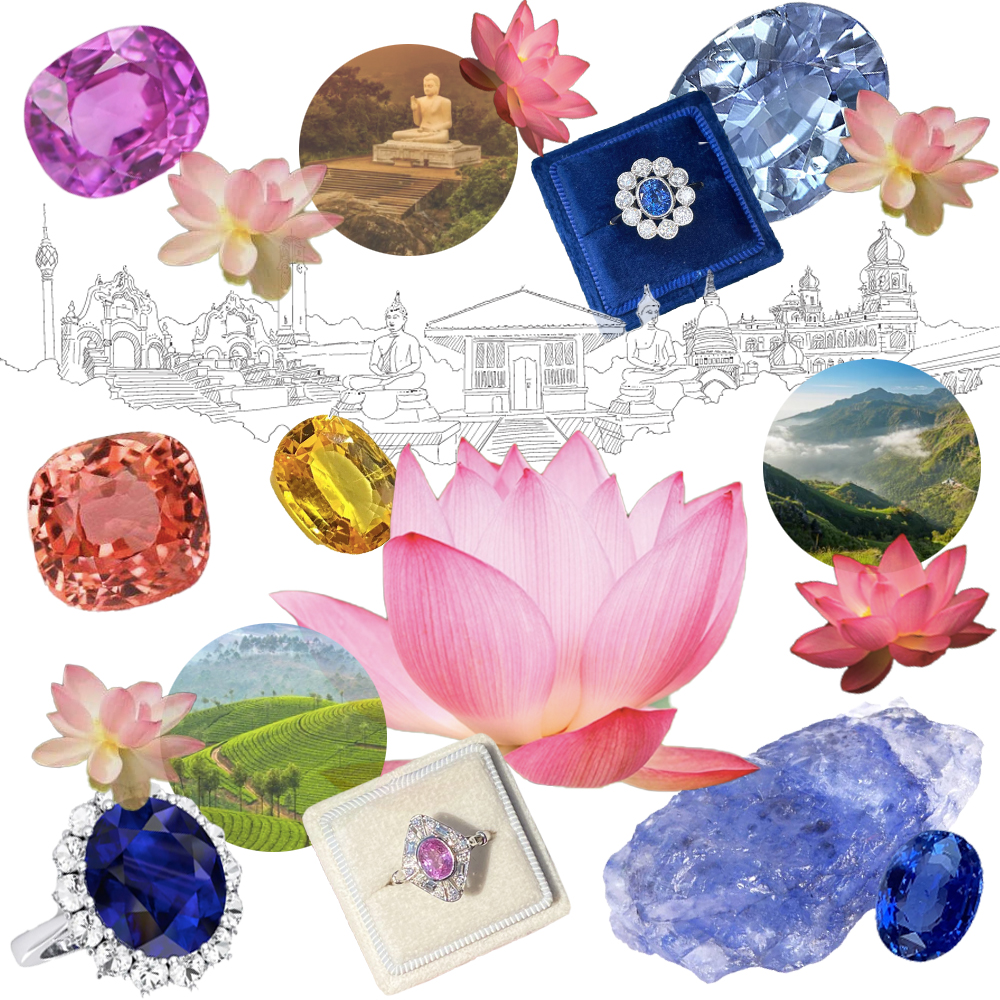
The island of Sri Lanka continues to be one of the world’s most important sources of Blue and Fancy-Coloured Sapphires.
Sri Lanka, Island of Gems
Ceylon is an old name for the South Asian island now known as Sri Lanka. Located in the Indian Ocean, Sri Lanka is a small pear-shaped country with a population of approximately 22 million people. It’s a primarily Buddhist nation with a rich cultural heritage which includes being part of the ancient Silk Road. Extraordinarily, it has long been known as the “island of gems,” as it enjoys ideal geological conditions that has led to it being incredibly abundant in high quality jewels. In fact, the island is one of the world’s richest concentrations of gems, including 40 different mineral species.
Source is important when it comes to gemstones because it can add historical context, the idea of scarcity, and the specific geological conditions of each location often affect the most important characteristic of a jewel, which is colour. Since Sapphires are found in more places in the world that the rest of the “big three,” which also includes Emeralds and Rubies, you’ll sometimes see source listed with Sapphires more often as a way of distinguishing their value, as well as describing their colour.
500 to 600 years ago, Sri Lanka was actually located in the middle of an ancient supercontinent. While seemingly the plot of a movie, this true slice of its history means that millions of years ago, perfect levels of pressure and heat ensured Sri Lanka would be rich in metamorphic gems for millions of years. Due to erosion, most of Sri Lanka’s gems are found in alluvial deposits, which refers to locations that are away from their original rock formation, such as riverbeds and streams.
What makes Ceylon Sapphires so special?
Sri Lanka has been supplying the world with fine quality Sapphires for over 2000 years, and some historians believe it is actually the world’s very first source of Blue Sapphire on earth. Along with Kashmir (which is no longer in operation) and Myanmar (also referred to as Burma), Sri Lanka is known for producing some of the world’s finest qualities of Sapphires in every colour. (A certain famous Blue Sapphire and Diamond halo engagement ring features a 12 carat Blue Ceylon Sapphire.)
Similar to Rubies, Sapphires that are sourced from metamorphic rock tend to be the most prized because their environments are low in Iron, which allows the gems to maintain a vibrant, bright hue. Iron is generally more prolific in basalt rock conditions, such as those in Australia, and tends to give Sapphires a darker tone and greenish tint.
Which colours are Ceylon Sapphires available in?
While gemstones can vary in tone and colour regardless of where they’re sourced, Blue Ceylon Sapphires are generally thought of as having an ideal violet-blue to blue colour, often referred to as “cornflower blue,” which is lighter and brighter than most. Any Sapphire which isn’t blue is considered a “fancy-coloured Sapphire” in the trade and Sri Lanka is famously considered a producer of the widest range of fancy colours in the world, including top quality Yellow, Pink and Purple varieties. It is particularly famous for Star Sapphires and Padparadscha Sapphires, a pinky-orange variety which gets its name in part from the Sinhalese word for lotus flower.
While there are tests that can be performed by a gemologist and organizations such as the GIA to determine the geographic source of a gem, keep in mind that one of the many unique traits of coloured stones versus Diamonds is how they are mined. Coloured gems are often sourced in a much more independent and artisanal manner, versus having large corporate structures behind them which track their every move. So, by their very nature, coloured gems, including Sapphires of every colour, tend to pass through many hands, sometimes even in border towns, and pinpointing the exact, original source can be tough for anyone to 100% guarantee. While geographic terms need to be used as accurately as possible, it’s important not to lean on them too heavily, and instead, use them to further inspire your love of jewellery, its history, and the stunning variety of colours they possess.
Comments Off on Katherine James Jewellery Custom Content, May 2022
Posted on03/27/2022|Comments Off on Katherine James Jewellery Custom Content, March 2022
What are Cabochon Cuts?
This ancient gem cut will never go out of style and including it in your collection will ensure it sings of history.
Before there were several types of gem cuts and shapes available including custom, fantasy and designer cuts created with high-tech machinery and lasers, gem traders had very little resources in the way of shaping and refining the Earth’s greatest materials.
While many gemstones are still cut by hand, the earliest forms of hand-cut gems took the shape of beads, followed by ancient cabochon cuts (sometimes just referred to as “cabs.”) Read more about the history of gem cutting.
Cabochons are dome-shaped, often with a round or oval-outline and a flat bottom. Double-cabochons are domed on top and bottom. The etymology of the word “cabochon” comes from an Old French term meaning little head.
Which gems are cut into cabochons and why?
While cabochons are often used to show off a gem’s excellent colour and saturation (which is any jewel’s most important value factor) they can also be ideal for specimens which may have slightly lower clarity. Some gem varieties can only be cut as cabochons due to their physical structure or if they are classified as “phenomenal.” The latter includes Star Sapphires and Rubies, which require the smooth surface to show off their natural asterism, chatoyant gems, such as Cat’s Eye Chrysoberyl, Moonstones, and Opals, which display a magical play-of-colour effect. Cabs are also known to hold-up better to scratches than a standard faceted cut.
When was the Cabochon cut popular and why?
This ancient cutting method was also in high demand during the Art Deco period, when exotic jewellery styles really came into fashion. These included carved cabochons, which were particularly common in the Indian-inspired “Tutti-Frutti” style, which was popularized by Cartier. Opaque gems including Turquoise, Lapis Lazuli, Jade, Onyx and Malachite, are also most often cut into cabochons as well as other cabochon variations, including carved cameos and intaglios.
What is a Sugarloaf cut gem?
The “Sugarloaf” cut is another much-loved variation of the cabochon, which is quite unique and eye-catching, and was also quite popular during the Art Deco period. This cut uses a square base, but has tapered edges along its dome that come to a soft point.
When looking at modern day cabochon-cuts, be sure to look for a symmetrical dome shape that is pleasing to the eye, as well as an even and symmetrical outline.
Comments Off on Katherine James Jewellery Custom Content, March 2022
Posted on03/26/2022|Comments Off on Katherine James Jewellery Custom Content, March 2022
Coming Up Roses
You may not be too familiar with these stunning pink gemstones just yet, but there’s no doubt they are the perfect jewels to add some history and romance to your collection.
What is Kunzite?
Kunzite is one of three varieties of the mineral Spodumene—but the only one you’ll likely every find in a piece of jewellery. Its unique name comes from the well-known gemologist George Frederick Kunz (who famously worked for Tiffany & Co.), and discovered a large deposit of the mineral in California in 1902.
Kunzite is a stunning gem that is found in light pink to violet hues. While watercolour-like colours are beautiful (and currently quite popular), in general, the more intense the saturation of this gem, the more valuable and prized it is.
Kunzite is most often mined in Afghanistan, Madagascar, Brazil and the U.S. state of California. Fine qualities of Kunzite remain quite rare, and even though it is highly valued by both gem collectors and jewellery designers, its low supply levels make it quite uncommon, and therefore still relatively unknown to many.
Kunzite is sometimes heat treated to improve it’s rosy colour, however keep in mind that regardless of whether it’s been treated or not, Kunzite has the very unique trait of sometimes fading when exposed to high heat or extreme light, so be cognizant of how you are storing these jewels when you’re not wearing them. It also rates a 6.5-7 on the Mohs Hardness Scale and has cleavage in two directions, meaning it has the potential to chip or split if it were to suffer a hard hit. However, mindful care and a well-made and protective setting can ensure this lovely gem stays in optimal condition for a lifetime.
What is Morganite?
Spodumene is often compared to Beryl, because they naturally occur in similar colours. Similar to Kunzite, Morganite is a rosy pink gemstone, which is a variety of Beryl (along with Emerald and Aquamarine.) These two gems also share similar origin stories when it comes to their namesake, and were even discovered around the same time. Morganite was actually named after another American gem enthusiast, and colleague of George Kunz, J.P. Morgan. Morgan, of course, was a famous financier with a love of mineral collecting, and in 1910, Kunz actually bestowed the name Morganite on this rosy mineral.
Finding Morganite, which gets its pink colour from manganese, in highly saturated hues is very rare, but it can vary from a light pink, to more salmon, peach and orangey colours, as well. In these combinations, it can even look similar to Padparadscha Sapphires. Similar to Kunzite, heat treatment is often used to intensify Morganite’s colour, and sometimes nix any yellow or orange tint. Unlike Kunzite, Morganite’s colour is stable and has no risk of fading when exposed to UV light or heat.
Some of the best Morganite on the market is known to come from Madagascar, though these specimens are now seldom available. Other major sources include Brazil, Mozambique, Namibia and the U.S. Similar to Aquamarine, Morganites grow in pegmatites, and can be found in excellent transparency and in very large crystal sizes. This makes them an especially good fit for cocktail rings, and excellent value for your money regardless of how you choose to include them in your jewellery collection. Of course, their beautifully romantic colours also make both of these unique and uncommon gemstones a lovely and thoughtful choice for engagement and anniversary rings and gifts.
Comments Off on Katherine James Jewellery Custom Content, March 2022
Posted on01/27/2022|Comments Off on Katherine James Jewellery Custom Content, January 2022
Pantone Colour of the Year 2022: Very Peri
Be ready to fall for Very Peri, an optimistic hue to start the new year
For over 20 years, the Pantone Colour Institute has released their colour of the year, based on a mind-bending collection of global research. To arrive at the lucky hue, experts examine a number of influential factors, including fashion and textile trends, new artists and exhibits, popular travel destinations, technological developments, film and other forms of entertainment in productions, social media platforms, upcoming sporting events, socio-economic and political conditions, home furnishing, product packaging, and really, all other matters of design.
For 2022, the Institute has named a completely new colour, which they’ve dubbed Very Peri—undoubtedly a play on periwinkle blue. While institute says the colour is considered part of the blue family (which is often used to communicated stability) but with a violet-red undertone, it is clear that this shade is in fact, purple!
According to Pantone, the choice represents an “altered landscape of possibilities, opening us up to a new vision as we rewrite our lives. Rekindling gratitude for some of the qualities that blue represents complemented by a new perspective that resonates today, Very Peri places the future ahead in a new light.” Clearly inspired by the world’s hopes and optimism for finally putting the daily worries of the pandemic and overall isolation behind us, other inspirations for the shade include the growth of digital art and design, including the rise of NFTs, the new “dynamic virtual world” (hello, Metaverse), gaming trends, and the overall fusion of the colours of our physical world with those we see on-screen.
If all these ideas of a new, virtual world have you feeling a bit lost, the good news is that the colour Purple, while perhaps a bit polarizing for some, is undoubtedly imbued with a feeling of fun, vibrancy, and overall frivolity and richness. After all, it’s a symbol of royalty and rarity, and also can be seen as the coming together of two distinct colour families: red and blue.
It’s a refreshing symbol of optimism for the future that is much welcomed, especially when you consider the shades forecasted by the institute in recent years, including a very industrial-sque pairing of grey and yellow, and a basic, banker’s blue.
Of course, we think the most exciting part of Very Peri, is how it will translate to our jewellery boxes! After years of blue and pink gems dominating the market, a return to purple feels fun again. While Amethysts, which were once considered of the rarest and most-sought after gems will likely come back into fashion in a big way (look for all saturations to return to glory, from a pale lavender to the richest purple), we also have our eye on Purple Sapphires, which have been extremely uncommon in the past if only because they were in the shadow of their royal blue counterparts, as well of course, for Kunzites and Tanzanites. Both are a rarity in the gem world, which customers are clicking to more and more in order to add massive future value to their collections, with Tanzanite in particular likely to soon ride a new wave of fame, thanks to their limited availability (with only once source, many experts agree they are likely to disappear altogether in the near future.)
Comments Off on Katherine James Jewellery Custom Content, January 2022
Posted on10/26/2021|Comments Off on Katherine James Jewellery Custom Content, October 2021
Oh, So Retro!
Mid-century jewellery will forever be loved for paving the way towards a new type of glamour.
What is Retro Jewellery?
After the heyday of ultra-glamourous Art Deco jewels, the Second World War ushered in a new era of design. Born out of the necessities of restraint and war-time restrictions, the Retro jewels of the 1940s and 50s took on a new feminine aesthetic that was optimistic, without the need for the flash of large gemstones and expensive settings.
Instead, due to the restrictions on Silver and Platinum, pieces were often crafted in Rose Gold—an alloy of gold mixed with more widely available copper. (Read more about alloys and Precious Metals.) Since sourcing large gemstones, including Daimonds and rare gems such as Sapphires and Emeralds, was becoming too difficult during war times, jewellery designers got creative with uplifting flora and fauna designs featuring smaller accent stones on the must-have items of the day, including brooches, hat pins and even cigarette and vanity cases. Bouquets of flowers were a particularly popular motif, and perfect for allowing smaller-cut gems to shine. Charms also became quite fashionable, since they showcased the wearer’s personality without necessarily requiring any gems at all.
Unlike the splashy post-war decadence of the 1920s, the period after the Second World War was still tense with an air of anxiety and lavish spending on luxury items was not returning to fashion as quickly as the first time around. In the UK specifically, the government’s new post-war “purchase tax” was raised from 30% to 125% and made luxury goods such as jewellery nearly impossibly expensive to produce and purchase. However, the latter didn’t mean that jewellery wasn’t still on the menu. In a way, it was a as popular as ever, just with a few budget-conscious adjustments.
Regardless of the lack of resources, men and women were still feverish with “proper” dress, and jewellery and accessories were as popular as ever. While men turned to tie pins and cufflinks to complete their look, matching jewellery sets including bracelets (worn with or without gloves) and bib-style necklaces were all the rage for ladies about town. Pricier Diamonds also took a backseat to cheerful, coloured gemstones which were less expensive and easier to find in large, eye-clean sizes, including Amethyst, Citrine, Smoky Quartz and Aquamarine.
Not dissimilar to the Art Deco period, which was in many ways a post-WWI rejection of the frivolity and romanticism of the Edwardian period, the 1950s and 60s ushered in a sleeker design sensibility which represented more freedom, prosperity and excitement for the future. These styles, which were at their height of popularity in the 1950s, are now known as Mid-Century Modern. Scandinavian designers such as Georg Jenson were particularly popular, and showed off more streamlined designs with geometric patterns and chunkier accent stones.
Comments Off on Katherine James Jewellery Custom Content, October 2021
Posted on09/05/2021|Comments Off on Katherine James Jewellery Custom Content, September 2021
The Grandeur of Garnets
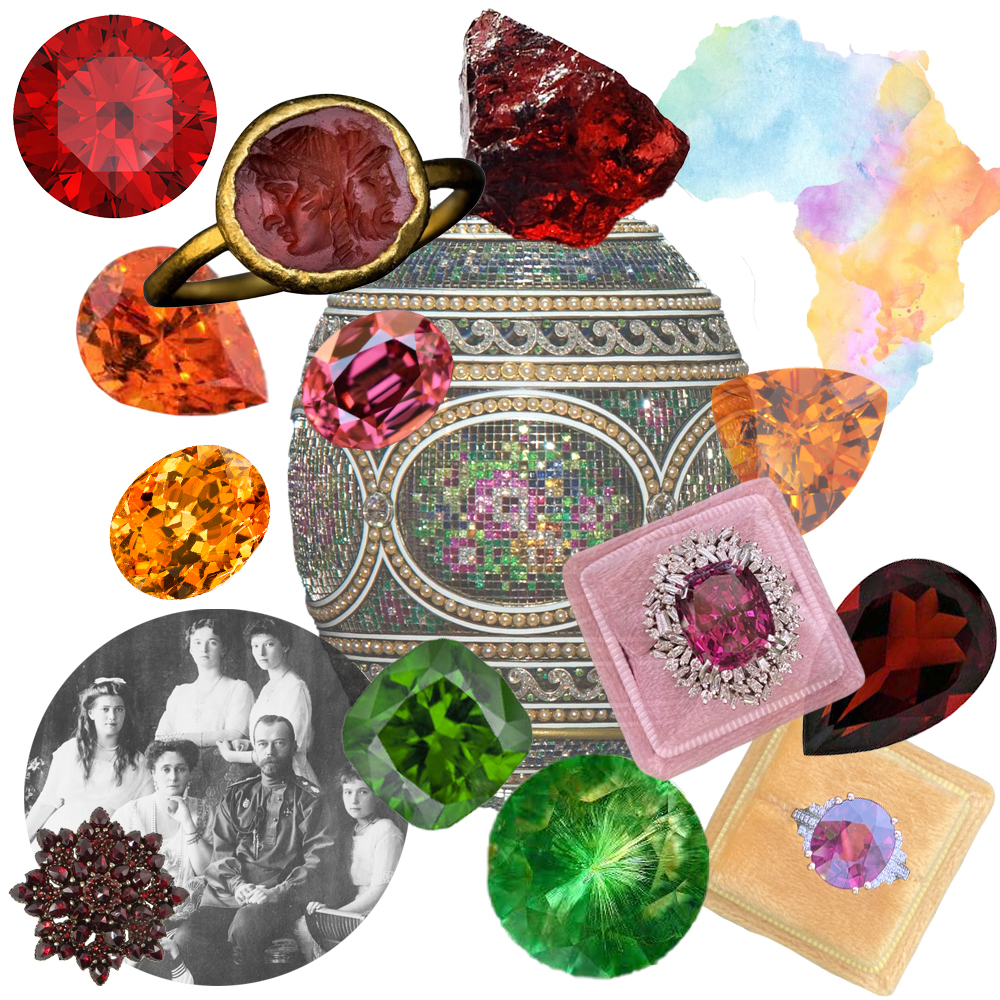
Red Garnets grace museums around the world as priceless artifacts, they’ve been buried with Egyptian pharaohs, carved in the signet rings of ancient Rome, and decorated the nobility and clergymen of the middle ages. Now, they’re just as popular as ever, especially for those with January birthdays. Red Garnets are arguably the most well-known to the public, especially since they can be sourced on almost every continent. The name Garnet is derived from the latin word for grain/seed – Granatus, likely a reference to pomegranate seeds, which can be very similar in size and colour to Garnet crystals, however, this special gem actually comes in a wide variety of highly sought-after colours, a few of which are some of Earth’s rarest minerals.
Similar to Tourmalines, Garnets are actually an entire group of minerals, (rather than a species such as corundum, which is Sapphire) so they are quite an intricate gemstone, with a large variety of chemical compositions and species. They are so complex, in fact, that many Garnets, such as the gorgeous raspberry red Rhodolite variety, are actually a combination of multiple species.
Like Diamonds and Spinels, the Garnet group quite uniquely belong to the cubic crystal system, which means their crystals form in cube-like structures and that they are singly-refractive. The latter helps some Garnet species reflect light in a way which allows them to sparkle in a stunning way, very comparable to the alluring fire of Diamonds.
Why are Green Garnets so Valuable?
Green Garnets, also known as the Tsavorite and Demantoid varieties, are some of the most valuable and sought-after green gems in the world. Demantoid Garnets were first found in Russia in the 1800s and became very popular with the Royal family as a personal favourite of Czar Nicholas II. They were also used often in the creations made by Faberge at that time. Demantoid Garnets famously owe their lovely green colour to trace amounts of Chromium, just like Emeralds. However, they also contain traces of Iron, which is what gives them their trademark yellowish tint. Demantoid Garnet’s most notable trait is their incredible dispersion, which gives them amazing fire and sparkle, similar to Diamonds. They range from yellowish to brownish green, but their most valuable colour is a true, intense green, very similar to Emerald. They are also the only gem with the potential to show “horsetail” inclusions—a fan like group of wispy inclusions, which can greatly increase their rarity and already very considerable value. Dementoid Garnets are still found in Russia, as well as Namibia, Italy, Iran, Mexico and Greece. However, their sources are far and few between, which of course ensures their prices remain incredibly high.
In contrast, Tsavorite Garnets weren’t actually discovered until the 1960s. Equally beautiful, Tsavorite Garnets get their green hue from Vanadium (also similar to some Emeralds), and can also range from a yellowish green to bluish green, with the most sought-after hues being in the bluish green to true green range. When green Garnet doesn’t possess enough saturation to be truly labelled a Tsavorite, it is sometimes referred to as a “Grossular Garnet.” While some Tsavorites are found in Pakistan, the most popular source is East Africa, including Tanzania, Kenya and Madagascar.
Both Demantoid and Tsavorite Garnets are highly rare in large, eye-clean sizes, especially over three carats. Therefore, they are most often used as small accent stones or in pave-style designs. They remain extremely valuable in any size, and are most valued for their strongly saturated colour and incredible Diamond-like sparkle.
What are Orange Garnets?
Orange Garnets, which get their colour from Manganese and trace Iron, are known as Spessartine Garnets. Their beautiful and lively colour range is as broad as the hues of a flame: from a light yellowish-orange to bright orange, fiery red, and dark brownish red. However, the most valuable (by a mile) are those with an intense, reddish-orange hue with medium to medium-dark tone. While Spessartine Garnets used to be considered rare, collector’s only gems, new discoveries in Africa including in Nigeria, Madagascar, Namibia, Tanzania and Zambia, have made them much more accessible to the public in recent years. Other sources also include California, India, Pakistan, Sri Lanka and Brazil. While they’ve become more accessible, prices for large, high-quality stones still remain at a premium and the interest in this gorgeous and uniquely-hued stone remain high, especially since orange gemstones remain more unconventional in the gem world.
The Popularity of Red Garnets
While deep red Garnets have been gracing jewellery boxes for thousands of years, we now know that not all red Garnets are created equal. For example, the finest raspberry-coloured Rhodolite Garnet can easily pass for a stunning Rubellite Tourmaline, or even Ruby. While the range of their colour can include a light reddish-purple to a deep berry red, these gems are most valuable when they have an intensely saturated hue, but are still bright and sparkle with reflected light. Garnets with areas of “extinction,” which are dark, nearly black, shadowy areas in the gemstone which aren’t able to reflect light, are common but certainly not considered the finest example of this lovely stone. These very deep red Garnets are technically a combination of the Pyrope and Almandine species, but are most commonly referred to as simply Almandine Garnets. Since they could often look so close to black, they were very popular in Victorian-style jewellery. While red Garnets were first discovered in North Carolina in the late 1800s, they are now most commonly found in East Africa, including in Tanzania and Madagascar, as well as India and Sri Lanka.
Comments Off on Katherine James Jewellery Custom Content, September 2021





 Megan Kirkwood
You must be logged in to post a comment.